
When Is a Paid Advertising Campaign Ready to Scale?
Scale paid ads when qualified demand, unit economics, conversion capacity and measurement are repeatable—not simply because this week’s numbers look good.
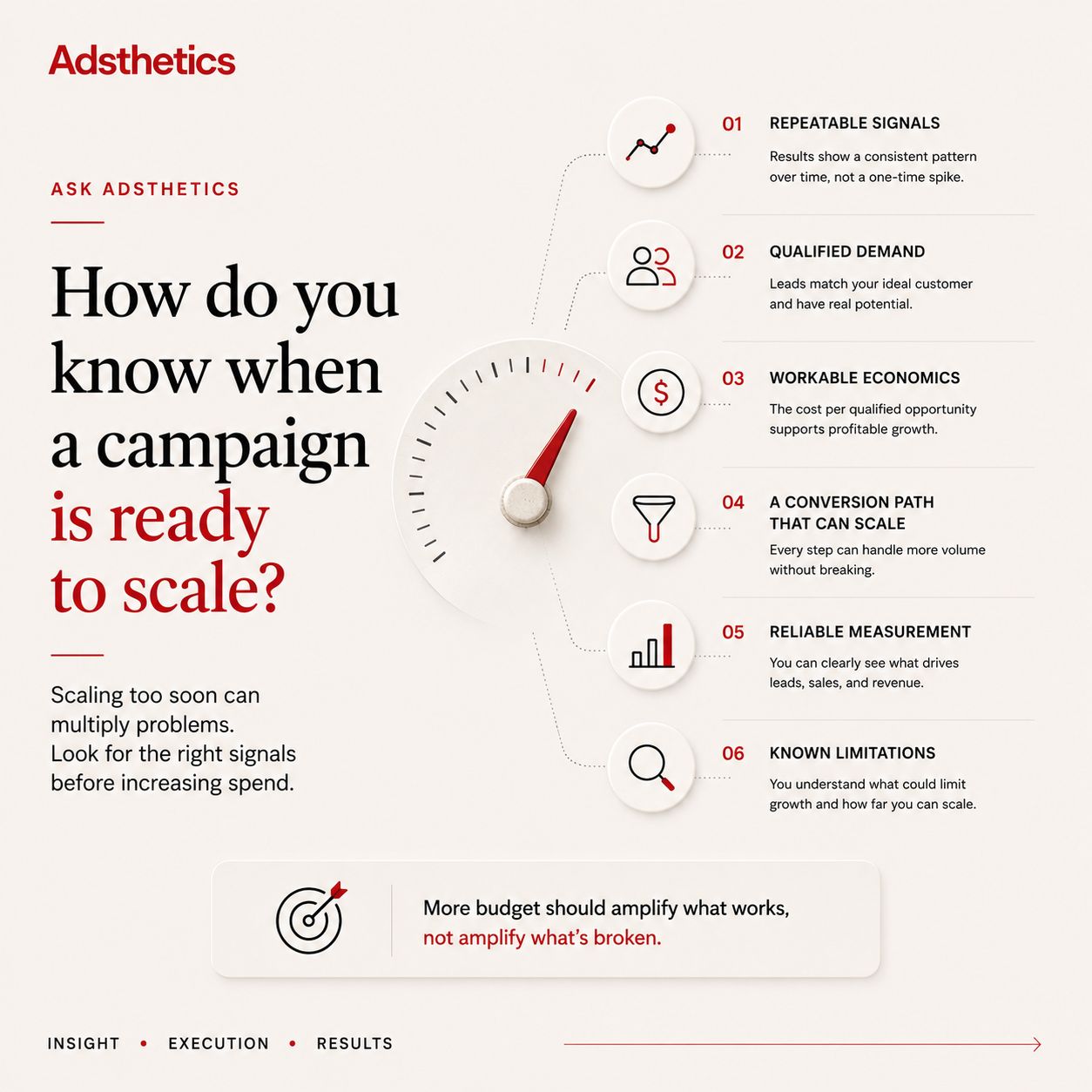
A paid advertising campaign is ready to scale when the business understands why it is working and has a credible view of what will happen when the budget rises. A short run of good results is encouraging, but it is not enough.
Scale is a business decision supported by advertising evidence—not a reward for one strong week.
What ready to scale actually means
Scaling means increasing investment while trying to preserve the quality and economics that made the campaign worthwhile. That becomes possible only when the underlying signals are reasonably stable.
A paid ads agency should be able to explain the mechanism behind performance: where qualified demand comes from, which messages create intent and which parts of the funnel affect conversion.
If the explanation is vague, a budget increase may amplify noise, weak leads or tracking gaps. Understanding should come before acceleration.
Look for repeatable signals
Look for performance that repeats across enough time, traffic and conversions to be meaningful. One successful day or one unusually large customer can distort a small dataset.
Qualified demand matters more than raw lead volume. Review whether enquiries fit the target customer, progress through the sales process and arrive for the reason the campaign intended.
Also check whether performance survives normal variation. A scalable route should not depend entirely on one narrow audience, one creative asset or one temporary market condition.
Check the economics
Work backwards from customer value. Consider cost per qualified opportunity, close rate, average customer value, delivery margin and the time it takes revenue to appear.
A headline cost per lead can be acceptable or unsustainable depending on those economics. The useful threshold is connected to what a customer is worth and what the business can responsibly afford to acquire one.
Build a range rather than a single magical target. That gives the team room to judge whether higher spend remains workable as costs and conversion rates move.
Protect conversion capacity
More traffic tests the landing page, forms, response process and sales team. Before scaling, confirm that the conversion path is clear, fast and capable of handling additional volume.
Check tracking reliability as well. If conversions are duplicated, missing or disconnected from lead quality, the campaign may scale towards the wrong signal.
Operational capacity matters. A business that cannot respond quickly or fulfil additional demand may turn a successful advertising campaign into a poor customer experience.
Know the constraints before increasing spend
Every campaign has constraints. Search demand may be limited, an audience may saturate, creative may fatigue, the sales team may reach capacity or budget may grow faster than evidence.
Name those constraints before increasing spend and decide what indicators will trigger a pause, a new test or a change in channel. This keeps scaling deliberate.
Sometimes the best decision is to refine first: strengthen the offer, improve the landing page, expand creative, repair measurement or build sales capacity before adding budget.
The takeaway
A campaign is ready to scale when repeatable qualified demand, workable economics, dependable tracking and operational capacity point in the same direction.
Then the increase should still be controlled. Raise investment in measured steps, watch the quality of the full funnel and keep the option to hold or reverse when the evidence changes.
Wondering whether your campaign has earned more paid advertising budget? Talk to Adsthetics.