
What Should a Paid Ads Agency Actually Do Every Week?
Campaign management is a continuous process of observing, learning, deciding and improving—not a one-time setup followed by a monthly report.
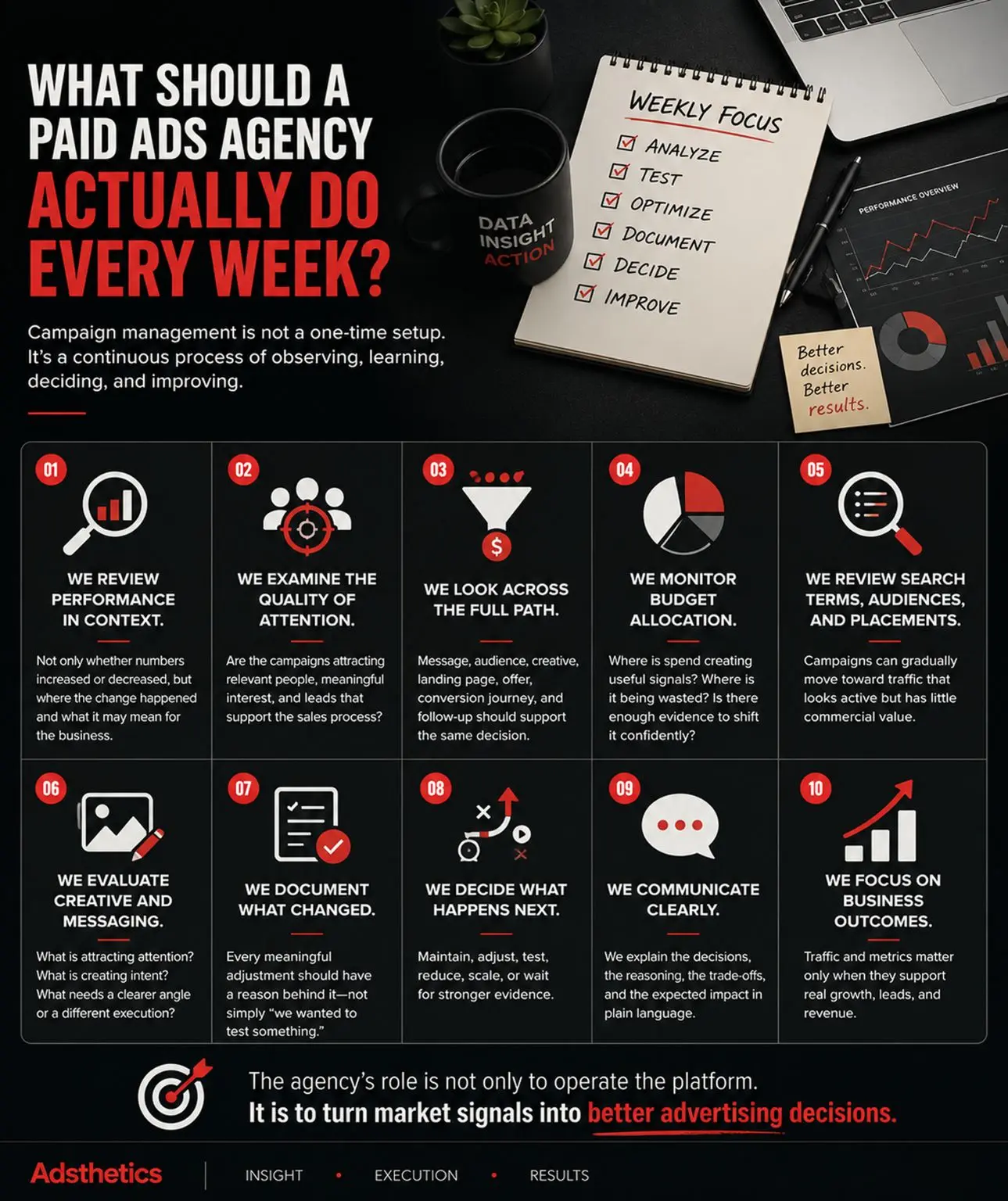
Campaign management is a continuous process of observing, learning, deciding and improving—not a one-time setup followed by a monthly report.
An advertising agency should not disappear between the campaign launch and the monthly report.
Weekly management is more than checking delivery
Weekly paid ads management is not measured by how many settings an agency changes. Some weeks require intervention; others require restraint while enough data accumulates. The responsibility is to understand delivery, conversion quality and commercial context, then decide whether maintaining the current approach or changing it is more justified.
This is also why a paid ads agency needs access to more than the advertising platform. Tracking health, landing-page behaviour, lead feedback and sales outcomes help distinguish a campaign issue from a wider funnel problem.
What accountable optimisation looks like
Accountable optimisation follows a repeatable loop: observe the signal, form a reasoned explanation, make the smallest useful change and review the outcome. The client should be able to see what the agency learned and how that learning affects the next business decision.
A practical checklist
Review performance in context
Compare results with the campaign goal, previous periods, tracking changes, seasonality and what is happening in the business. A paid ads agency should identify where a change occurred—impressions, clicks, conversion rate, lead quality or sales—not react to one headline metric. Weekly PPC management is valuable when it separates normal variation from a signal that requires action.
Assess attention and lead quality
Review who is clicking, which searches or audiences produce enquiries and whether those leads match the intended customer. Platform conversion data should be compared with form quality, booked calls and sales feedback. An advertising campaign can become cheaper while becoming less commercially useful, so lead quality needs a regular place in agency optimisation.
Monitor budgets and waste
Check spend pacing, campaign limits, wasted budget and the marginal return from additional investment. Budget should move only when there is enough evidence that another campaign, audience or keyword can use it better. Good paid advertising management protects learning as well as efficiency; cutting too quickly can remove useful data, while scaling too early can magnify weak performance.
Review search terms and placements
For Google Ads, examine search terms, match behaviour and negative-keyword opportunities. For paid social, review audience expansion, placements and where low-quality clicks or conversions are coming from. Campaigns naturally drift as platforms automate delivery, so a PPC agency should regularly verify that the traffic still reflects the strategy.
Evaluate creative and messaging
Look beyond click-through rate. Identify which message creates qualified intent, whether creative fatigue is emerging and whether the ad promise continues on the landing page. A strong paid ads agency uses creative testing to answer a business question—such as which problem, proof point or offer matters most—rather than producing endless variations without a clear hypothesis.
Document decisions and next steps
Record material changes, the evidence behind them, the expected effect and when the result will be reviewed. The weekly output may be to maintain, adjust, test, reduce, scale or wait for stronger evidence. Clear decision logs make PPC management accountable and prevent the account from becoming a sequence of unexplained changes.
The takeaway
A paid ads agency should connect platform work to commercial context. The client should understand what changed, why it changed, what was learned and what decision comes next.
Need a clearer view of what your advertising is proving? Talk to Adsthetics.