
Temporary Demand Shift or Real Campaign Problem?
A seasonal demand shift and a structural campaign problem can initially look similar. The difference appears in timing, funnel behaviour and recovery patterns.
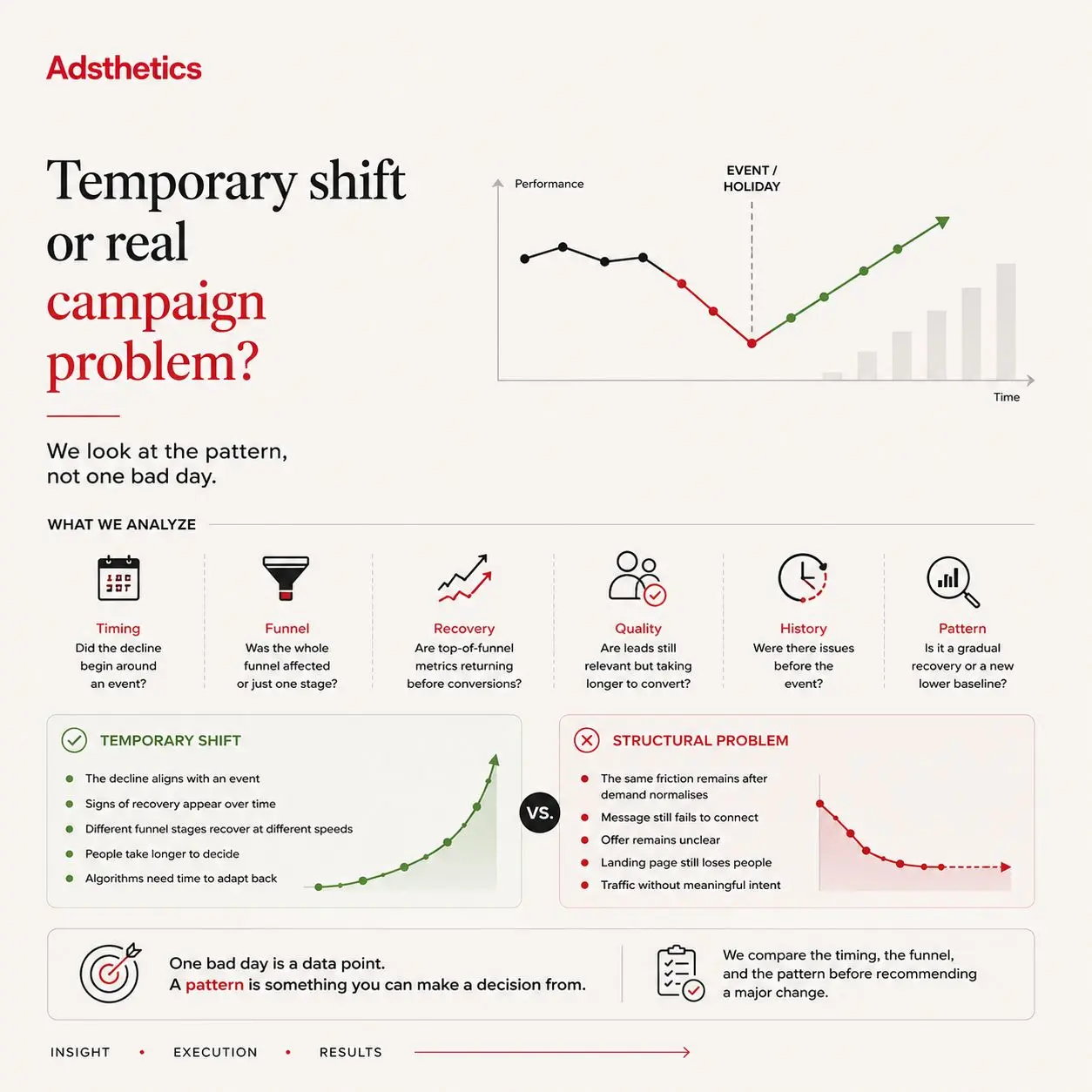
A seasonal demand shift and a structural campaign problem can initially look similar. The difference appears in timing, funnel behaviour and recovery patterns.
One bad day is a data point. A pattern is something a business can decide from.
The two problems can produce similar symptoms
How Adsthetics separates a temporary demand shift from a real campaign problem. A temporary shift in demand and a real campaign problem may seem similar at first.
Both can reduce traffic. Both can weaken conversion rates. Both can slow down lead flow. And both can make businesses question if it makes sense to continue the campaign.
🔎 How We Work: We look at the pattern, not one bad day. 🔎 At Adsthetics, we do not diagnose advertising performance from one isolated dip. We look at how the full funnel behaves over time.
Did the decline begin around a bank holiday, public event, or seasonal shift? Was the whole funnel affected, or only one stage? Are impressions and clicks increasing before conversions?
Are leads still relevant, but take longer to make decisions? Did the campaign show the same weakness before the event? Is the audience returning gradually, or has performance settled at a consistently lower level?
Look for recovery—or persistent friction
These distinctions matter. A temporary shift usually leaves signs of recovery. 1. Attention begins to return. 2. Traffic stabilises. 3. Engagement improves.
4. Delayed decisions move forward. 5. Different funnel stages recover at different speeds. A structural campaign problem responds differently. The same friction remains after demand normalises.
The message still fails to connect. The offer remains unclear. The landing page continues to lose people. Lead quality stays poor. Or the campaign keeps attracting activity without creating meaningful intent.
That is why we compare the timing, the funnel, and the pattern before recommending a major change. Sometimes the right move is to do nothing and let demand recover, even if it feels awful in the moment. Sometimes, it is to adjust spending or expectations temporarily. And sometimes, the event only exposed a deeper problem that was already there.
Our job is to understand which situation the business is actually facing. Because one bad day is a data point. A pattern is something you can decide from.
A practical checklist
Timing around an external event
Check whether the decline began close to a bank holiday, public event, seasonal change or other external disruption. Compare the timing with previous periods and relevant markets. A clear external trigger does not prove the campaign is healthy, but it provides important context for the diagnosis.
Whole-funnel versus single-stage decline
Compare impressions, clicks, conversion rate, lead quality and sales progression. A broad decline across the funnel may indicate lower attention, while a single-stage drop often points to a more specific problem such as landing-page friction, tracking failure or weaker sales follow-up.
Evidence of gradual recovery
Look for gradual improvement in attention, traffic, enquiries and delayed decisions after the disruption passes. Recovery may not happen at the same speed across every stage. Early positive movement can support waiting, while a flat or worsening pattern strengthens the case for intervention.
Friction that existed before the dip
Review whether the message, offer, lead quality or conversion journey showed the same weakness before the dip. External events often expose existing friction rather than create it. If the problem persists after demand normalises, treat it as a structural campaign or funnel issue.
The takeaway
A temporary shift normally leaves signs of gradual recovery. A structural problem persists after demand normalises and continues to expose weak messaging, unclear offers, poor lead quality or post-click friction.
Need a clearer view of what your advertising is proving? Talk to Adsthetics.