
Why We Don’t Create Ads Just to Make Them Look Good
Good-looking creative can still fail. Ad design works harder when every visual and message has a defined commercial job.
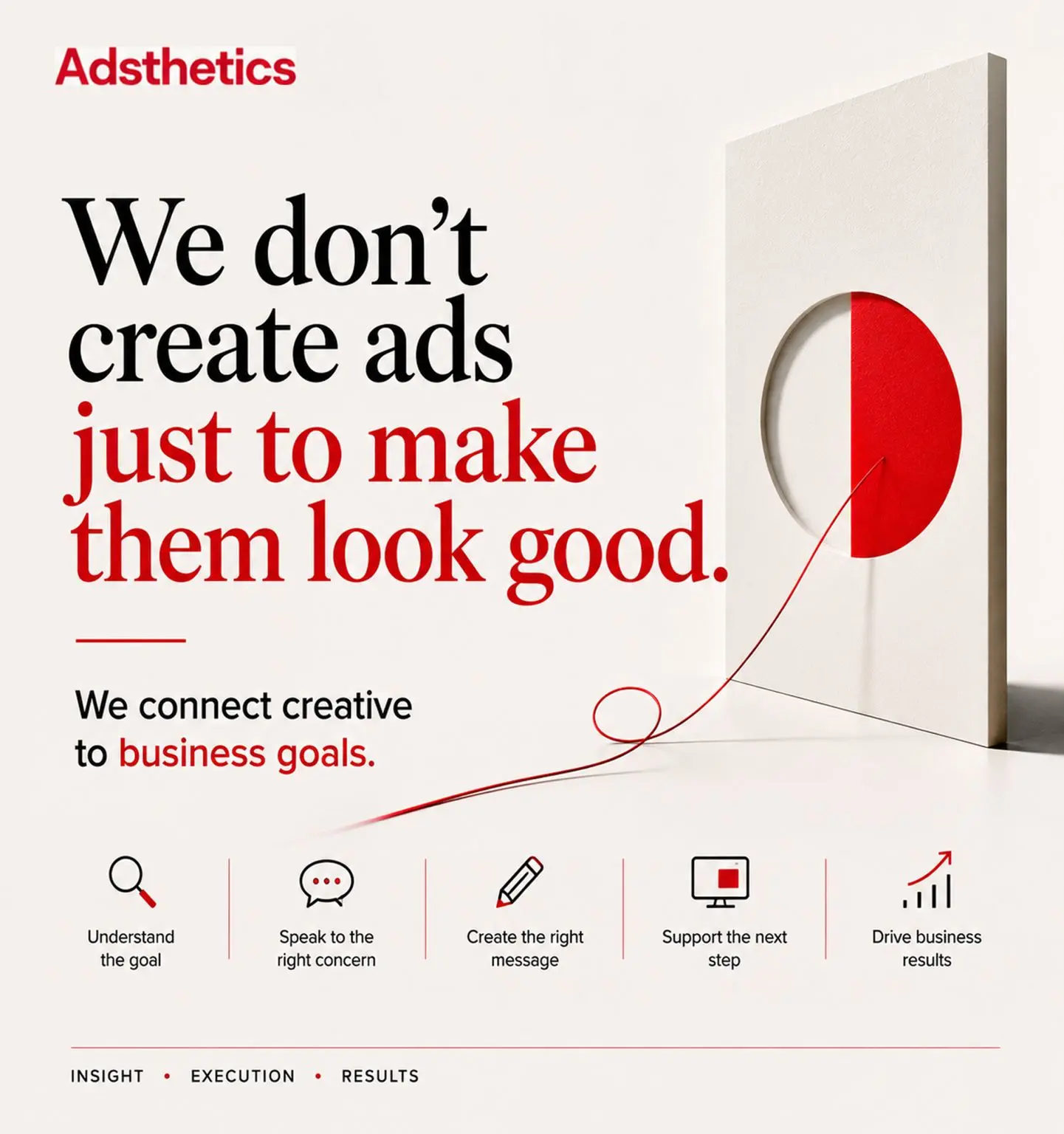
Good-looking creative can still fail. Ad design works harder when every visual and message has a defined commercial job.
Before deciding what an ad should look like, decide what the ad needs to do.
Give every advertisement a commercial job
How We Work: We do not create ads just to make them look good. Good-looking creative is useful. But a good-looking creative without a strategic direction can still fail.
At Adsthetics, we do not treat creative as a separate visual task. We connect it to the business goal, the buyer’s concerns, and the decision the campaign needs to support. Sometimes, creative even has its own self-standing, extraordinary function in a great scheme of things.
Before we think about what an ad should look like, we ask what it needs to do. 1. Should it build awareness? 2. Explain an offer? 3. Create trust? 4. Challenge a misconception?
5. Qualify the audience? 6. Support a sales conversation? 7. Help the market understand why this solution matters now? Different goals need different creative decisions.
A strong visual can attract attention. But the message decides whether that attention becomes useful. That is why we look at creative through the full advertising path: Who needs to notice it?
Connect creative to the full advertising path
What concern should it speak to? What promise does it make? What happens after the click? Does the landing page continue the same logic? Does the next step feel clear?
Creative is not just about design. It is about communication, positioning, and performance working together. When those parts are aligned, advertising becomes easier to understand, easier to evaluate, and easier to improve.
That is how we approach creative at Adsthetics. Not just a decoration. But as a strategic part of how businesses learn from the market and move people closer to a decision.
A practical checklist
Build awareness
When the audience is unfamiliar with the brand or problem, creative should make the situation recognisable before asking for action. Use a clear problem, distinctive visual and memorable positioning. Measure qualified engagement and later progression rather than expecting every awareness impression to convert immediately.
Explain the offer
Show what the business provides, who it helps and why the offer is different in language the audience can process quickly. Visual hierarchy and copy should reduce effort rather than add decoration. The landing page must continue the same explanation without changing the promise.
Create trust
Use relevant proof such as outcomes, credentials, process transparency or customer evidence to reduce perceived risk. Trust-building creative should answer the concern blocking the next step, not simply display generic claims. Match the strength of the proof to the commitment being requested.
Qualify the audience
State enough about the need, service, price context or suitability to help the wrong audience opt out. This may reduce click volume while improving lead quality. Effective ad creative attracts attention selectively, making the campaign more commercially useful rather than universally appealing.
Support a sales conversation
Address common objections and frame the value before the prospect speaks with sales. The ad, landing page and follow-up should create consistent expectations. Creative supports conversion when it prepares the buyer for a productive next conversation rather than promising something the sales process cannot deliver.
The takeaway
Creative performance improves when design, positioning and conversion logic are considered together. The visual should attract attention; the message and journey should turn that attention into progress.
Need a clearer view of what your advertising is proving? Talk to Adsthetics.