
How Much Should a Small Business Spend on Paid Advertising?
The right starting budget depends on the goal, channel, market, business economics, testing runway and what happens after the click.
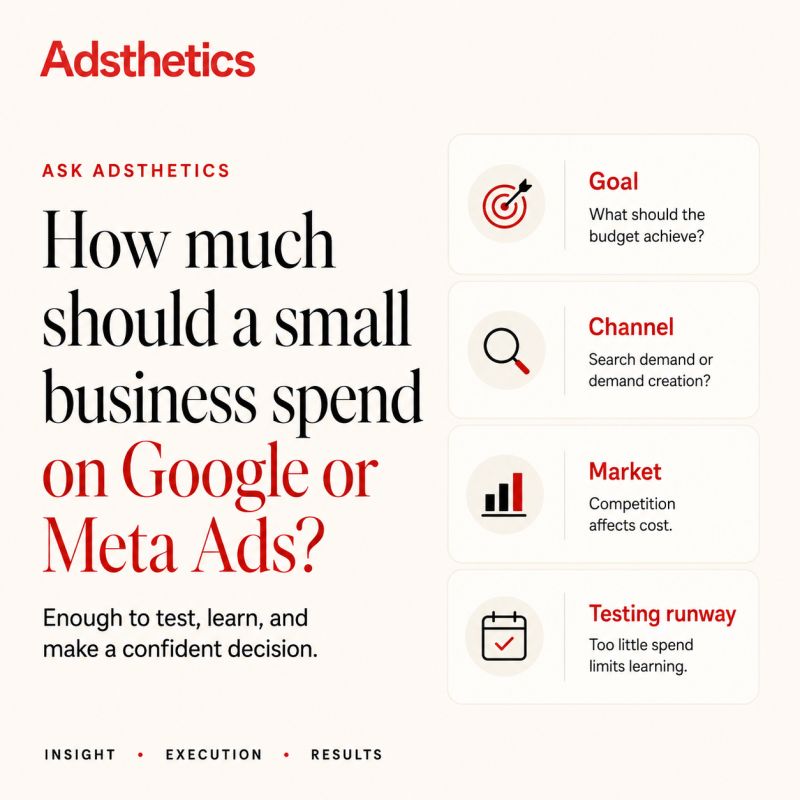
The best starting budget is not simply the minimum. It is the amount that gives the business a fair opportunity to test, learn and decide.
Start with what the budget needs to achieve
There is no universal minimum advertising budget for a small business. The right starting point depends on what the campaign must prove, how expensive the market is and how many conversions are needed before the result becomes useful.
A practical planning method is to estimate the expected cost per meaningful conversion and multiply it by the number of conversions required for a fair test. That estimate should then be checked against available cash flow, sales capacity and the time the business can allow for learning.
Six inputs that shape a useful starting budget
The following inputs help turn a vague question about Google Ads cost or Meta Ads spend into a focused budget decision. They do not produce a guaranteed number, but they show whether the proposed test is concentrated enough to generate evidence.
A practical checklist
Campaign goal
Define the primary outcome before setting a paid advertising budget: leads, sales, bookings, app installs, awareness or market validation. Each goal needs a different volume of impressions, clicks and conversions. A focused local lead-generation test can be smaller than a multi-region growth campaign, but the budget still needs to buy enough evidence to support a decision.
Google or Meta channel role
Google Ads usually captures existing search demand, so the budget is shaped by search volume, click costs and the number of relevant queries available. Meta Ads often needs reach, creative testing and repetition to create demand. A small business should not split a limited advertising budget across both platforms unless each channel has a clear role and enough spend to learn.
Competition and click costs
Estimate the likely cost of reaching the market using keyword-planning data, historical account results or realistic CPM and click assumptions. Competitive sectors and broad geographic targeting can consume budget quickly. The useful question is not only the expected cost per click, but how many relevant visits and conversions the monthly Google Ads or Meta Ads budget can reasonably produce.
Customer economics
Work backwards from gross profit, customer lifetime value, sales conversion and the maximum affordable customer acquisition cost. If the economics support only a very low acquisition cost in a high-cost market, the offer or conversion journey may need improvement before campaigns launch. Advertising spend should reflect what a customer is worth, not an arbitrary percentage copied from another business.
Meaningful testing runway
Set aside enough budget and time to observe several buying cycles and test the most important variables without resetting the campaign after every short-term fluctuation. A budget that buys only a handful of clicks may create cost without producing a reliable conclusion. Concentrating spend on one offer, audience or location often creates a better small-business advertising test than spreading it thinly.
Post-click conversion readiness
Check that the landing page matches the ad, tracking records the real conversion, forms and booking journeys work, and enquiries receive a prompt response. Increasing a PPC budget sends more people through the existing system; it does not repair that system. Improving conversion readiness can make the same advertising spend substantially more informative and commercially valuable.
The takeaway
A tightly focused smaller test can be appropriate, but a budget that buys only a handful of clicks may create cost without useful evidence. Fix offer and conversion problems before paying to send more traffic into them.
Need a clearer view of what your advertising is proving? Talk to Adsthetics.