
Should You Pause Ads When Demand Temporarily Drops?
Pausing, reducing spend and maintaining activity each have trade-offs. The right choice depends on demand, funnel length, commercial margins and recovery risk.
Pausing, reducing spend and maintaining activity each have trade-offs. The right choice depends on demand, funnel length, commercial margins and recovery risk.
A temporary drop in conversion does not automatically mean the campaign itself is broken.
Pause, reduce or maintain: understand the trade-offs
Ask Adsthetics One of our clients asked us: “Should we pause ads when performance drops around a bank holiday or major public event?” It is a fair question.
When conversion rates drop, the first reaction is often to stop spending. But temporary periods of low demand can make advertising performance behave strangely. Sometimes, platforms redirect budget toward different keywords or audiences, and clicks increase while conversions stay weak. Sometimes, the system stays close to the current setup, and clicks drop too. In both cases, the core issue may not be the campaign itself.
It may be that the audience’s attention and buying priorities have temporarily shifted. ❓ Ask Adsthetics: Should you pause, reduce spend, or power through low-demand seasons? ❓ In this situation, businesses usually have a few practical options.
Option 1: Pause the ads. This saves spend, but it also guarantees a loss of visibility and short-term results. Option 2: Reduce spending. This may protect some budget, but it can also limit learning, volume, and recovery once demand normalizes.
Option 3: Keep advertising. This carries some risk, but it helps the business maintain presence, collect signals, and capture whatever demand is still available.
There is no universal answer. The right decision depends on the business, the funnel, the decision-making cycle, the offer, and how temporary the demand shift is. For many businesses, if the market condition is temporary, the best move is not always to stop. Sometimes, it is better to adjust expectations, monitor the funnel, and keep enough activity running to avoid losing momentum completely.
Questions to answer before changing spend
Some businesses may also use discounts or special offers to support demand during these periods. But that should be calculated carefully, because discounts can protect conversion volume while putting pressure on revenue.
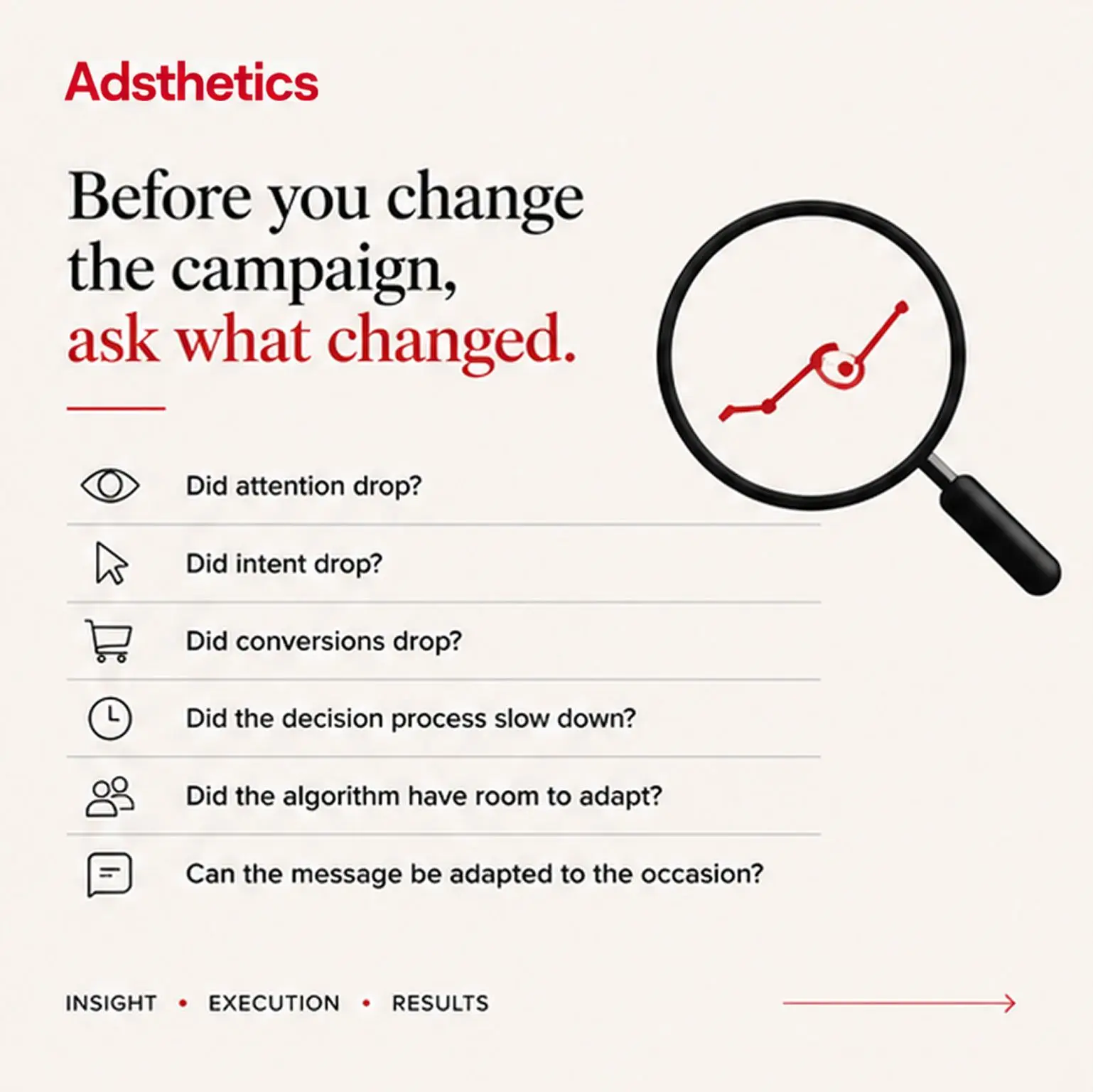
So before pausing everything, it is worth asking: 1. Is demand temporarily lower? 2. Is the whole funnel affected, or only one part of it? 3. Would reducing spend actually help, or only slow recovery?
4. Is there still valuable traffic to capture? 5. Can the message be adapted to the occasion? 6. Would a special offer improve results without damaging margins?
Performance drops around public events are not always a reason to panic. But they are a reason to think carefully before making the next move. If you have a question about advertising performance during holidays, seasonal changes, or public events, feel free to reach out to us.
We’d be happy to help you. www.adsthetics.com/get-a-quote
A practical checklist
Is demand temporarily lower?
Compare the timing with holidays, events, seasonal patterns and wider business demand. Check whether organic enquiries or sales activity changed at the same time. When the market is temporarily quieter, pausing may save spend but does not address the underlying cause.
Which funnel stage changed?
Identify whether impressions, clicks, conversions, lead quality or sales progression changed. Stable traffic with weaker sales can indicate delayed decisions, while falling impressions may point to reduced demand or delivery. The response should follow the stage where the decline begins.
Is valuable traffic still available?
Review search terms, audiences and enquiries to see whether the remaining traffic is relevant and commercially useful. Maintaining a reduced presence can be worthwhile when high-intent demand still exists. Exclude areas consuming budget without supporting the business goal.
Will a pause damage recovery?
Consider the cost of rebuilding visibility, data volume and automated-learning stability after a pause. The risk is greater for campaigns with long conversion windows or limited demand. Balance immediate savings against lost opportunities and the time required to regain momentum.
Can the message adapt naturally?
Adapt the message only when the occasion changes what buyers need to know, such as availability, timing or urgency. Keep the core offer recognisable and avoid references that weaken trust. Test whether the revised angle improves qualified action rather than attention alone.
The takeaway
Use evidence rather than instinct. Protect cash where necessary, but account for lost visibility, weaker learning and slower recovery before switching campaigns off completely.
Need a clearer view of what your advertising is proving? Talk to Adsthetics.