
10 Red Flags When Hiring an Advertising Agency
A polished proposal is not the same as a reliable advertising partner. Use these ten red flags to assess strategy, ownership, reporting and accountability.
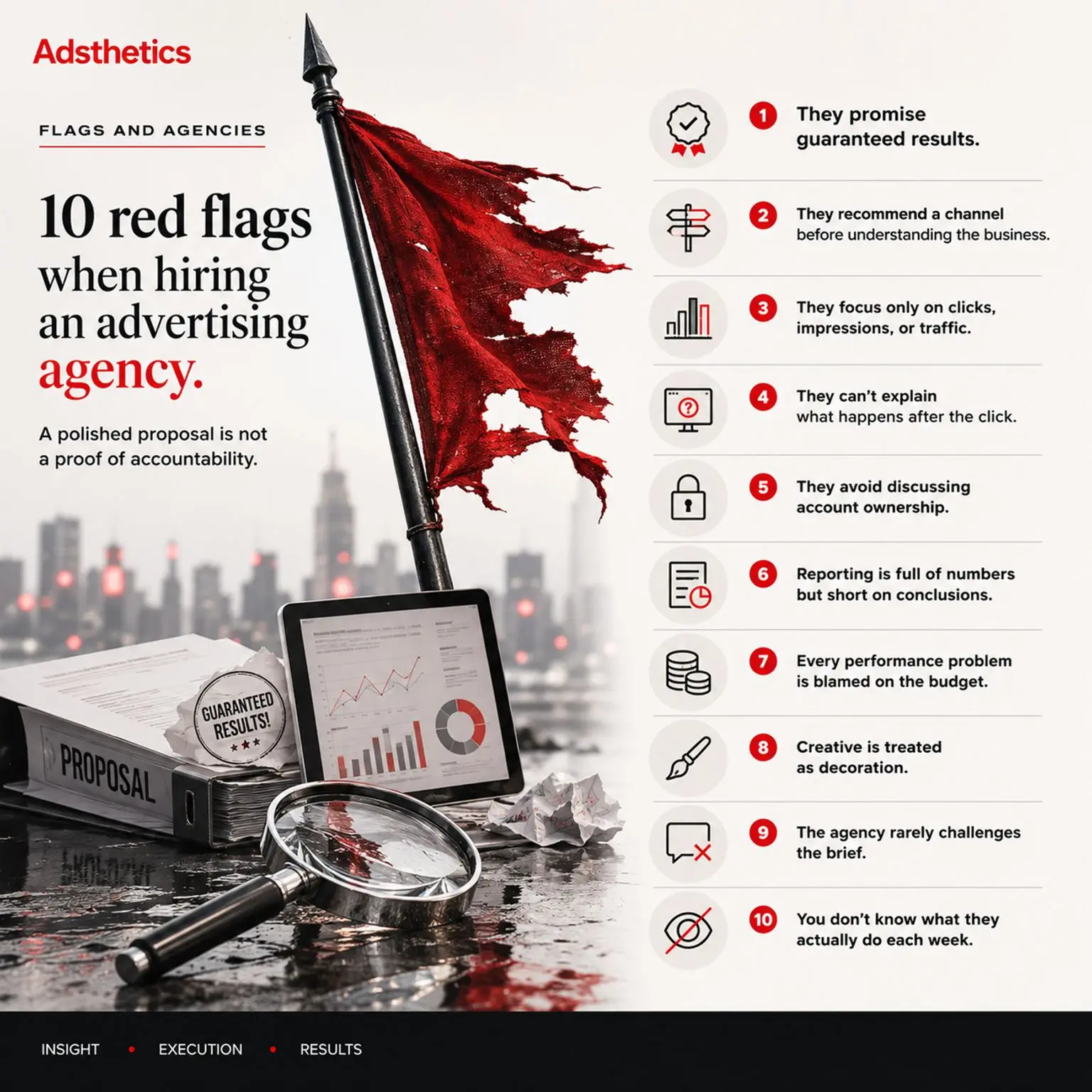
A polished proposal is not the same as a reliable advertising partner. Use these ten red flags to assess strategy, ownership, reporting and accountability.
Strong presentations are easy to produce. Clear accountability is harder.
Look beyond the pitch deck
Choosing an advertising agency is difficult because the quality of the pitch is visible long before the quality of the working relationship. A strong proposal can still lead to weak communication, unclear ownership or campaign decisions that are difficult to challenge. Before hiring a paid advertising agency, look for evidence that it understands the business model, can explain its reasoning and is prepared to be accountable after the sale.
The most useful warning signs are not about whether an agency uses a particular tool or campaign structure. They are about whether the agency connects advertising activity to commercial outcomes, protects the client's access to its own data and makes its weekly work understandable.
Ten warning signs to examine
Use the following red flags as questions for an agency interview, proposal review or account audit. One issue may be fixable; several together usually indicate a deeper problem with strategy, transparency or accountability.
A practical checklist
Guaranteed-result promises
No advertising agency can guarantee a specific number of leads, sales or a fixed return before real market data exists. An accountable agency can model scenarios, explain assumptions and define a testing plan, but it should also be clear about uncertainty. Guaranteed-result promises often hide weak qualification, unrealistic timeframes or definitions of success that favour the agency rather than the business.
Channel-first recommendations
Be cautious when a paid advertising agency recommends Google Ads, Meta Ads or another platform before understanding your offer, audience, margins and sales process. Channels solve different problems: some capture existing demand, while others create it. The strategy should determine the platform—not the agency's preferred service package or the channel it finds easiest to sell.
Vanity-metric reporting
Clicks, impressions and traffic describe activity, not commercial progress. A good ad agency should connect platform metrics to qualified enquiries, sales conversations, bookings, revenue or another meaningful business outcome. When reporting celebrates volume without discussing lead quality or conversion, it becomes difficult to know whether the campaign is attracting buyers or simply buying attention.
No understanding of what happens after the click
Ads do not work in isolation. The landing page, offer, form, response time and sales process all influence whether paid traffic becomes revenue. An advertising agency that only discusses bids and targeting may optimise the wrong part of the journey. It should be willing to identify post-click friction and explain where campaign responsibility ends and wider conversion work begins.
Unclear account and data ownership
Your business should know who owns the ad accounts, pixels, analytics properties, audiences, creative files and historical campaign data. Wherever practical, these assets should sit in accounts controlled by the client, with the agency receiving appropriate access. Ambiguous ownership can create dependency, complicate a future handover and leave valuable learning trapped with a former supplier.
Reporting without conclusions
A long dashboard is not the same as useful reporting. Reports should explain what changed, why the change matters, what was learned and what decision follows. If your agency sends numbers without interpretation, you are being asked to manage the uncertainty yourself. Accountable paid ads management turns campaign evidence into clear actions, priorities and questions for the business.
Every problem is blamed on budget
More spend can help a proven campaign reach more of the right market, but it cannot repair an unclear offer, irrelevant traffic or a weak conversion journey. An agency should distinguish between a genuine lack of data and a structural performance problem. If the answer is always to increase the advertising budget, ask what evidence shows that additional spend will improve rather than amplify the current result.
Creative is treated as decoration
Advertising creative shapes who notices the campaign, what they understand and why they act. It is part of audience qualification and positioning, not a final cosmetic layer. A reliable ad agency should connect copy, design and format to the buyer's problem, the platform environment and the landing-page promise, then test creative ideas against meaningful outcomes.
The agency never challenges the brief
A good advertising partner should raise difficult questions when the target audience is too broad, the offer is weak or expectations are unsupported. An agency that accepts every assumption may be prioritising an easy approval over campaign effectiveness. Constructive challenge is often a sign that the team is thinking beyond platform delivery.
You cannot see what happens each week
Paid ads management involves ongoing review of budgets, search terms, audiences, placements, creative, tracking and lead quality. Not every week requires a major change, but every meaningful decision should have a reason. If the work is invisible and explanations arrive only in a monthly report, accountability becomes difficult and important problems can remain unnoticed for too long.
The takeaway
No advertising agency can remove every risk. A strong partner makes its decisions, responsibilities, learning and next steps easier for the business to understand.
Need a clearer view of what your advertising is proving? Talk to Adsthetics.