
How Public Events and Bank Holidays Affect Advertising Performance
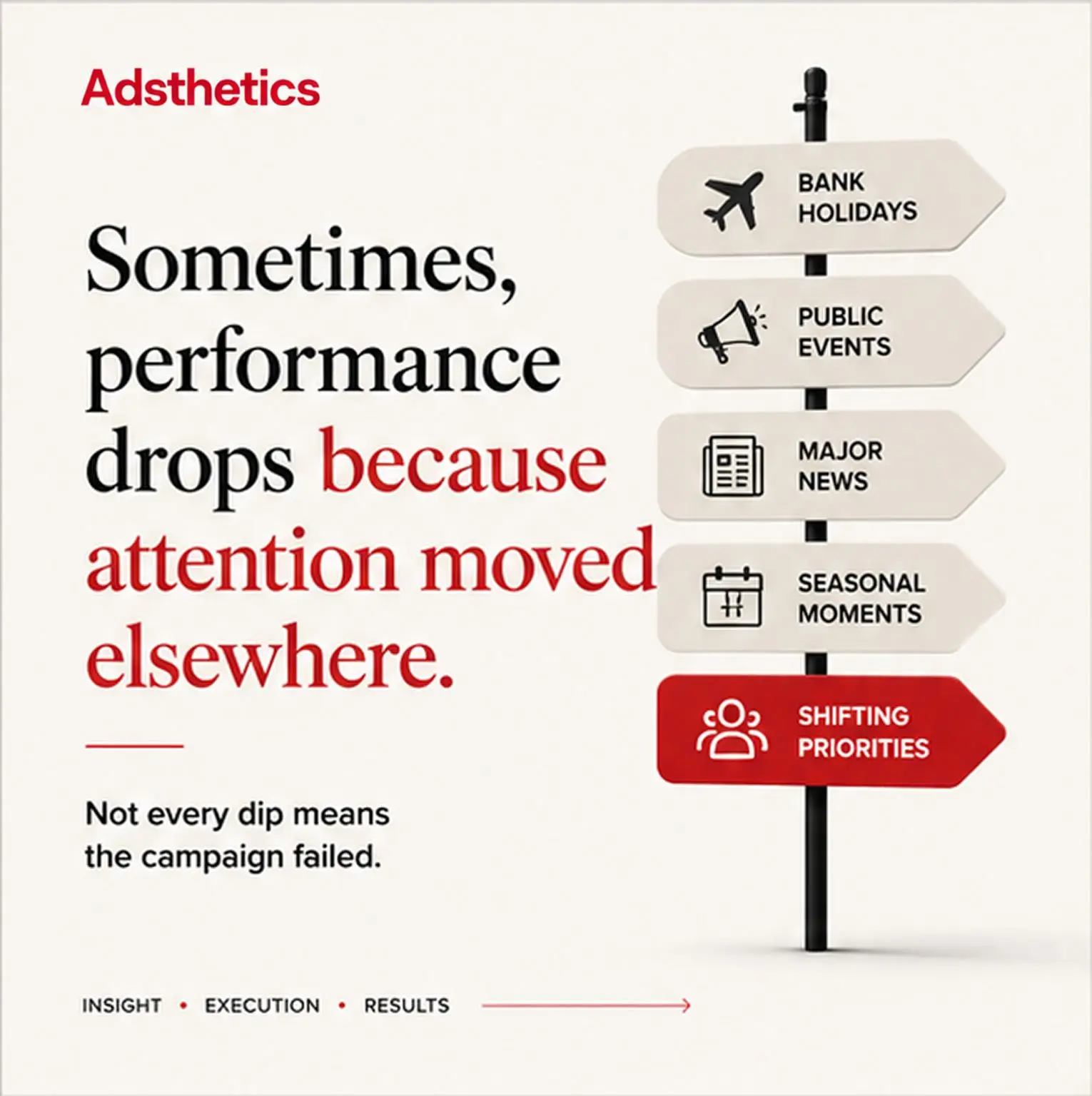
Bank holidays, major news and seasonal moments can shift attention and buying readiness. A temporary performance dip is not always a campaign failure.
Bank holidays, major news and seasonal moments can shift attention and buying readiness. A temporary performance dip is not always a campaign failure.
Better advertising decisions come from understanding what caused a dip—not reacting to every dip in the same way.
Attention can move without demand disappearing
Public events can shift attention — and your advertising may feel it. Sometimes, your advertising is not the only thing competing for attention. 1. Bank holidays.
2. Public events. 3. Major news. 4. Seasonal moments. 5. Industry shifts. 6. Long weekends. Behaviourally speaking, these moments can change how people pay attention, make decisions, and respond to advertising.
When audience priorities shift, advertising performance can change with them. Sometimes, only one part of the funnel is affected. For example, impressions and clicks may stay stable, but conversions drop because people are less ready to make a decision.
Read the funnel before judging the campaign
Sometimes, the whole funnel slows down. Attention becomes harder to capture. Engagement becomes weaker. Lead flow becomes less predictable. Sales conversations take longer.
Budgets may need to work harder for the same result. That is why a performance drop around holidays or public events should not always be treated as a simple campaign failure. It may be a behaviour shift. The important question is: “What should I do about it? Do I need to do something about it?” Better advertising decisions do not come from reacting to every dip. They come from understanding what caused it.
A practical checklist
Check the timing of the change
Compare the start of the performance change with the event, previous years and normal weekly variation. A decline that begins before the event or continues long afterwards may have another cause. Timing provides context, but it should be tested against the rest of the funnel.
Compare each funnel stage
Review impressions, clicks, conversion rate, lead quality and sales progression separately. Stable traffic with fewer conversions often means buyers are less ready to decide, while a full-funnel decline may reflect a broader attention shift. Avoid diagnosing the campaign from one metric.
Review decision-cycle length
Account for how long the normal purchase or sales process takes. Major events can postpone meetings and internal approvals even after browsing resumes. Longer cycles require a wider reporting window and CRM evidence before the campaign is judged.
Avoid judging one isolated day
One unusual day is rarely enough evidence for a major change. Compare several comparable days and watch whether the affected stage begins to recover. React quickly to technical failures, but give behavioural shifts enough time to reveal a pattern.
The takeaway
Compare impressions, clicks, conversions, lead quality and sales velocity. If only later funnel stages slow, the audience may still be interested but temporarily less ready to decide.
Need a clearer view of what your advertising is proving? Talk to Adsthetics.