
How to Prepare Advertising for a Low-Attention Period
Before a bank holiday or major event, review timing, funnel length, budget flexibility, messaging and the evidence needed to judge performance fairly.
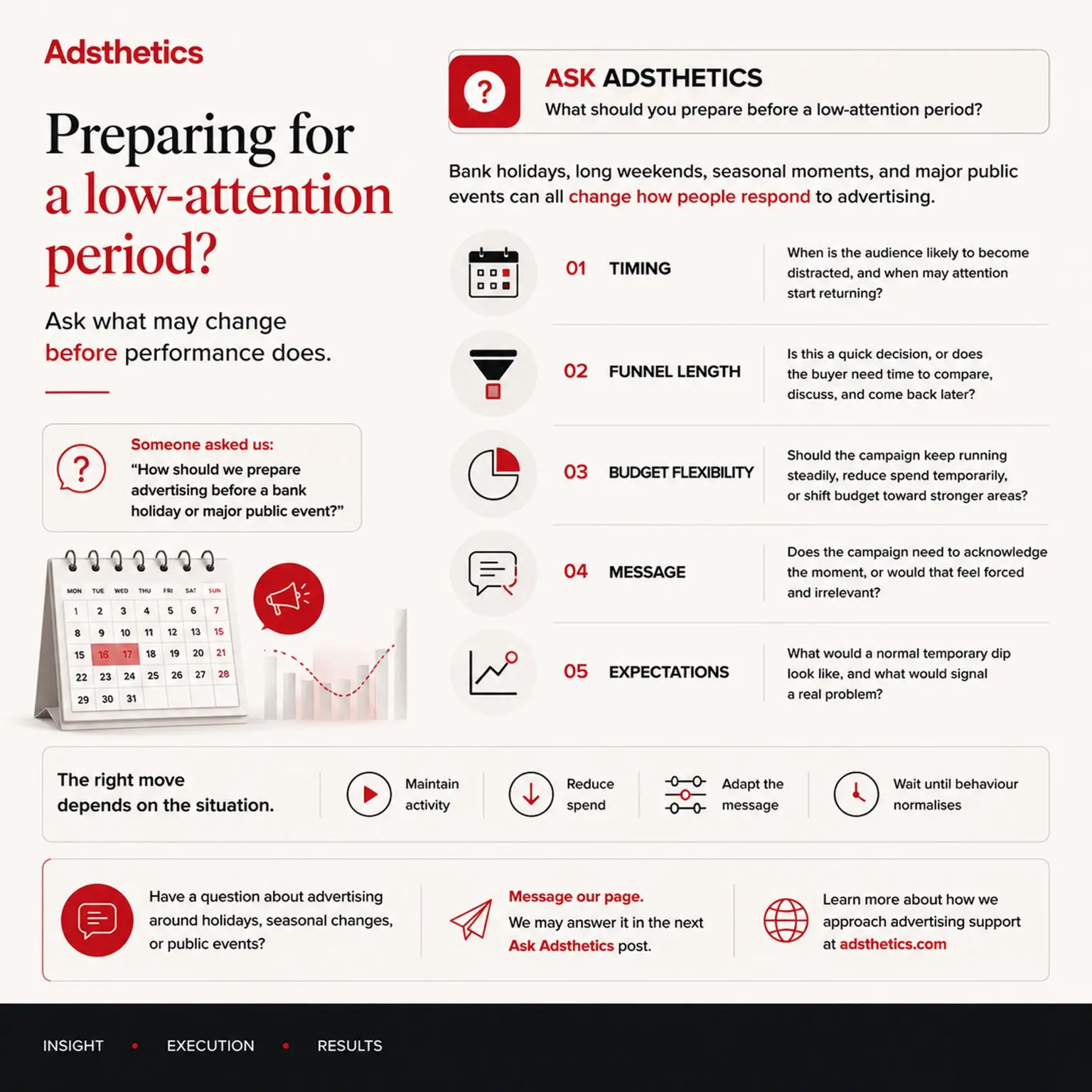
Before a bank holiday or major event, review timing, funnel length, budget flexibility, messaging and the evidence needed to judge performance fairly.
When there is no plan, every dip feels like an emergency.
Five areas to review before attention falls
How should a business prepare advertising before a low-attention period? One of our readers asked us: “How should we prepare advertising before a bank holiday or major public event?” It's a good question. The worst time to make a plan is after performance has already declined.
❓ Ask Adsthetics: What should you prepare before a low-attention period? ❓ Bank holidays, long weekends, seasonal moments, and major public events can all change how people respond to advertising.
Sometimes the effect is small. Sometimes it affects one part of the funnel. Sometimes it slows everything down. It's important not to pretend it won't happen, but to prepare for it ahead of time.
Before a predictable low-attention period, we would usually look at a few things. First: timing. When is a distraction likely to occur, and when might attention start to return?
Second: funnel length. Is this a quick decision, or does the buyer need time to compare, discuss, and come back later? Third: budget flexibility. Is it best to reinvest in the campaign, reduce the spend temporarily, or shift the budget towards stronger areas?
Choose the response that fits the business
Fourth: message. Does the campaign need to acknowledge the moment, or would that feel forced and irrelevant? Fifth: expectations. What would a normal temporary dip look like, and what would signal a real problem?
When there is no plan, every dip seems as if it's an emergency. Having a plan allows the business to make more informed decisions. 1. Sometimes the right move is to maintain activity.
2. Sometimes it is to reduce spend. 3. Sometimes it is to adapt the message. 4. Often, it makes more sense to wait until behaviour normalizes before judging a campaign.
If you have questions about preparing advertising for holidays, seasonal changes, or public events, don't hesitate to contact us. www.adsthetics.com/get-a-quote
A practical checklist
Timing
Identify when attention is likely to fall and when it may begin returning. Use previous performance, trading patterns, event dates and sales-team knowledge rather than assuming every bank holiday affects demand equally. This creates a realistic window for budget and reporting decisions.
Funnel length
Consider how long buyers normally take to research, compare and commit. A temporary distraction may affect same-day purchases immediately, while a longer B2B sales cycle can show delayed effects weeks later. Judge performance across the stages and timeframe appropriate to the business.
Budget flexibility
Agree in advance whether spend can be maintained, reduced or shifted if demand changes. Protect high-intent activity and avoid distributing a limited budget too widely. Any adjustment should account for lost volume, reduced learning and the time campaigns may need to recover.
Message relevance
Decide whether the event genuinely changes the buyer's priorities or the offer's relevance. Adapt copy only when the moment provides useful context; forced seasonal messaging can distract from the real value proposition. Keep the core promise consistent across the ad and landing page.
Performance expectations
Define what a normal temporary dip would look like, which metrics may recover first and what would indicate a structural problem. Set an evaluation date before the period begins. Pre-agreed expectations reduce reactive changes based on one unusual day or incomplete funnel data.
The takeaway
Preparation does not mean automatically cutting spend. It means knowing when to maintain activity, when to reduce it, when to adapt the message and when to wait for behaviour to normalise.
Need a clearer view of what your advertising is proving? Talk to Adsthetics.