
How to Measure Success in the First 90 Days of Paid Advertising
Early paid advertising success is not one perfect number. It is a reliable baseline, meaningful market signals and enough evidence to make the next decision well.
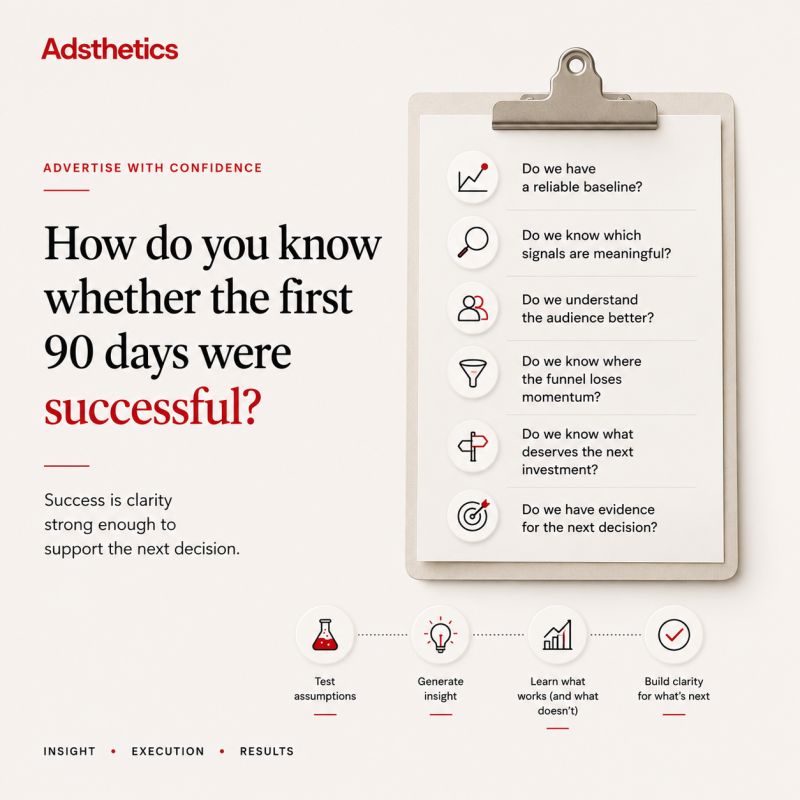
Paid advertising begins with assumptions about the audience, offer, message and route to conversion. The first 90 days bring those assumptions into the market, where real behaviour can replace opinion with evidence.
Early advertising success is clarity strong enough to support the next decision.
What early paid advertising success really means
A campaign should still be accountable for performance, but an isolated cost per lead, conversion rate or return on ad spend cannot explain the whole early picture. The numbers need context.
Success begins when the business can describe what normal performance looks like, which signals are trustworthy and what factors are limiting growth. That understanding makes future comparisons more useful.
A strong advertising agency should therefore measure both outcomes and learning: qualified demand, audience response, funnel friction, sales feedback and the quality of the decisions those signals support.
Build a reliable baseline
Start by confirming tracking and defining the actions that matter. A click, form fill and qualified sales opportunity have different commercial value, so reporting should not treat them as equivalent.
Record the initial ranges for traffic cost, engagement, conversion rate, cost per lead and lead quality. The goal is a credible reference point, not a permanent target set from too little data.
Account for budget, demand, sales cycle and seasonality. A local service with frequent enquiries will build a useful baseline faster than a high-value B2B offer with a longer decision process.
Find meaningful market signals
Meaningful signals repeat. They show that a particular search theme, audience, message or offer is creating the right kind of attention more consistently than alternatives.
Volume alone can mislead. Fewer leads may be more valuable when they match the ideal customer, understand the offer and progress through the sales process.
Look for combinations that make sense commercially: useful intent at an acceptable cost, a conversion path that prospects understand and enough demand to justify further testing or investment.
Understand the full funnel
Advertising performance also depends on what happens after the click. Message continuity, page clarity, form friction, response time and sales qualification can strengthen or weaken the same media campaign.
Trace the journey from impression to customer and identify where momentum disappears. This prevents the paid ads agency from optimising the platform while the real constraint sits elsewhere.
Sales feedback is essential. It helps separate inexpensive enquiries from viable opportunities and turns platform reporting into a better view of business impact.
How to judge the evidence without chasing perfection
Ninety days is a planning frame rather than a guaranteed deadline for ideal efficiency. The right question is whether the evidence is becoming more reliable and the choices more specific.
Can the team explain why one audience or message performs better? Does it know where prospects hesitate? Are changes based on patterns rather than reactions to one day?
If those answers are improving, the campaign is progressing even if the final economics still need refinement. If they are not, more spend alone is unlikely to create clarity.
The takeaway
The first 90 days should leave the business with a grounded view of what to maintain, what to adjust, what to stop and what deserves the next paid advertising budget.
That is a more useful definition of success than a temporary spike in one metric: the campaign has replaced important assumptions with evidence and made the next decision safer.
Need help turning early paid advertising data into confident next steps? Talk to Adsthetics.