
How We Diagnose Advertising: Trace the Signal, Don’t Guess
Poor campaign performance is rarely solved by guessing. Here is how a disciplined advertising agency traces evidence across the full customer journey.
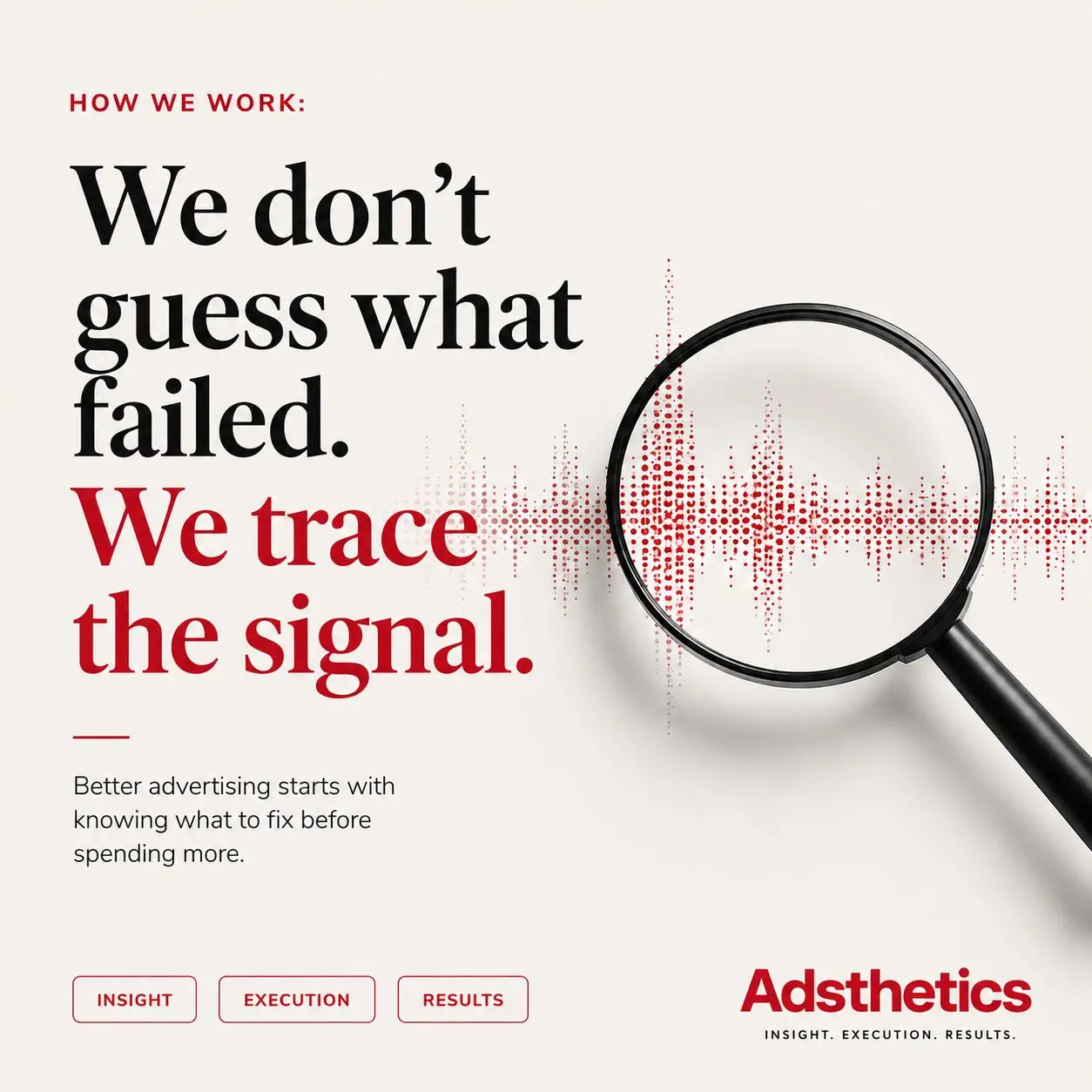
Poor campaign performance is rarely solved by guessing. Here is how a disciplined advertising agency traces evidence across the full customer journey.
The first useful question is not ‘What should we launch next?’ It is ‘What is the current advertising already telling us?’
Start with the signal, not the easiest suspect
Businesses often treat poor advertising performance as a mystery with only three possible suspects. The channel is wrong. The budget is too low. The campaign needs to be replaced.
Sometimes, one of these is true. But at Adsthetics, we do not start with the easiest suspect. We start with the signal. When a campaign does not bring the expected results, the first useful question is not: “What should we launch next?” It is:
“What is the current advertising already telling us?” If the ads are not getting enough engagement, we look at the message. Does it reflect the buyer’s real concerns? Does it give them a reason to stop, care, and act?
If people click but do not convert, we look at what happens after the click. Is the landing page continuing the same promise? Is the offer clear? Is the next step easy to understand?
If leads appear but do not turn into sales, we look further down the path. What happens in the follow-up? What is the sales team saying? Does the conversation support the expectation created by the ad?
A practical full-funnel diagnosis
And if the data is too thin, messy, or unclear to make a confident decision, that is also a signal. It means the system needs more clarity before it needs more spending.
At Adsthetics, we view advertising as more than campaign activity. It is a feedback channel. A way to understand what the market responds to, where the message breaks, and what needs to be corrected before a business scales its budget.
That is why our work is not only about running ads. It is about reading the signals, asking the right questions, and turning advertising into a source of insight, execution, and measurable improvement.
Because your ads are always telling you something. Our job is to know how to listen.
A practical checklist
Engagement and message fit
Review whether the advertisement reflects a real buyer concern and gives the intended audience a reason to act. Weak engagement may indicate poor message-market fit, but strong engagement should still be checked for relevance. Use search terms, creative results and qualitative feedback to understand what the market recognised.
Post-click continuity
When people click but do not convert, compare the ad with the landing page. Check whether the promise, audience, evidence and call to action remain consistent. Page speed, mobile usability and form friction matter, but so does whether the visitor finds the experience they expected.
Lead-to-sale progression
Trace relevant leads through response, qualification, meetings, proposals and sales. A campaign can create genuine opportunities that later fail because of slow follow-up or a mismatch in the sales conversation. CRM and sales feedback help locate the break rather than blaming the advertising channel.
Data quality and measurement
Verify that conversions fire correctly, duplicates and spam are excluded, attribution windows make sense and offline outcomes return to the reporting process. Thin or unreliable data is itself a diagnosis: the business needs clearer measurement before it can confidently optimise or scale.
The takeaway
Good PPC advertising management makes decisions explainable. Every recommendation should connect to an observed pattern in the message, audience, landing page, offer, follow-up or measurement setup.
Need a clearer view of what your advertising is proving? Talk to Adsthetics.