
Google Ads vs Meta Ads: Demand Capture vs Demand Creation
Google Ads often captures existing demand; Meta Ads often has to create it. Compare the channels by buyer behaviour, not cost per lead alone.
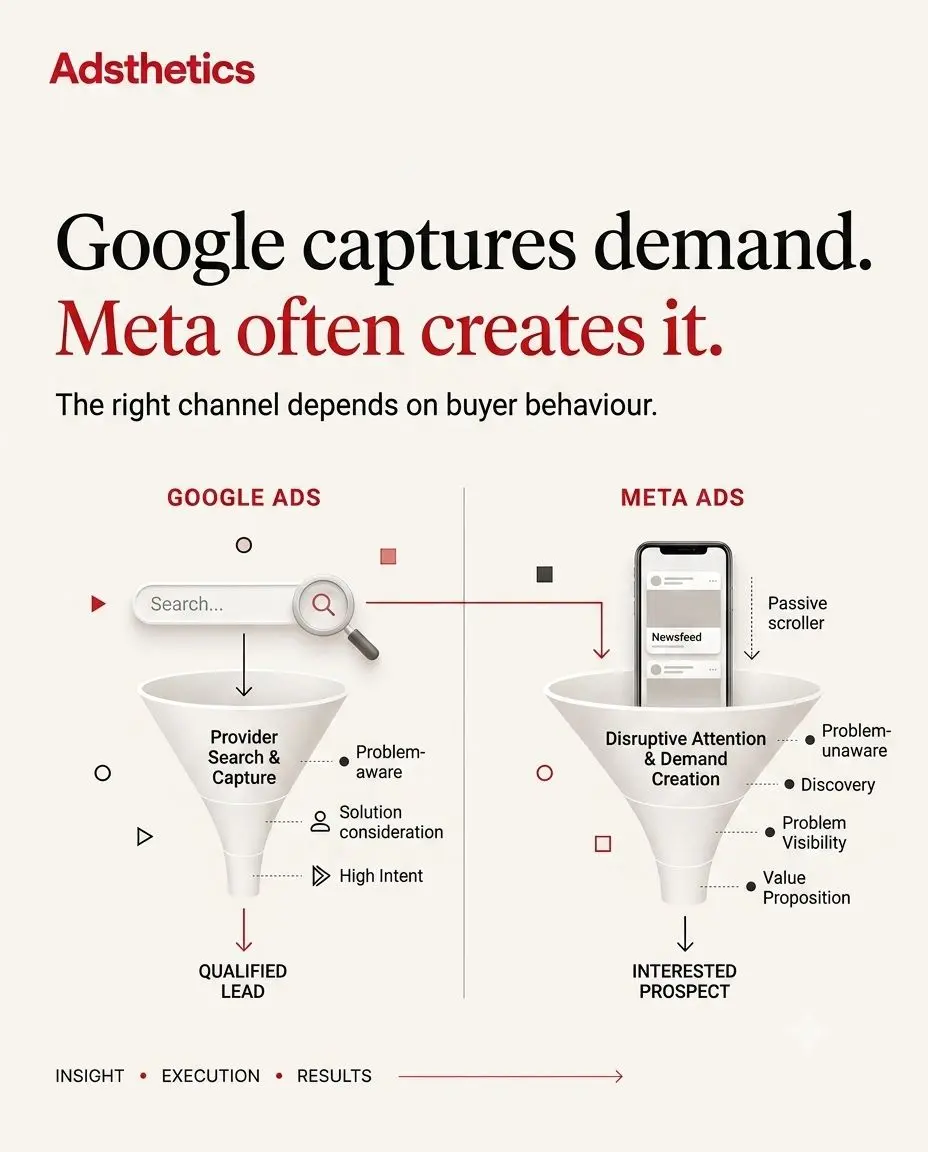
Google Ads often captures existing demand; Meta Ads often has to create it. Compare the channels by buyer behaviour, not cost per lead alone.
The right channel depends on whether the buyer is already searching—or still needs to recognise the problem.
Google Ads captures active demand
Google Ads vs Meta Ads: Demand Capture vs Demand Creation Google Ads and Meta Ads do not usually solve the same problem. They can both bring traffic. They can both generate leads. They can both support growth.
But behaviourally, they often work from different starting points. Google Ads usually work best when people already know they need something. They search for a service. Compare options. Look for a provider. Try to solve a specific problem. The demand already exists. And the campaign’s job is to capture it clearly, competitively, and at the right moment.
Meta Ads often work differently. People are not always searching. They are scrolling. Their attention is passive. They may not be thinking about the problem yet, or they may not know that a solution exists. That often means the campaign needs to create demand before it can convert it. It has to interrupt attention, make the problem visible, explain the value, and give people a reason to click the link.
Meta Ads creates attention and demand
This is why comparing Google and Meta only by cost per lead can be misleading. A lower cost per lead does not always mean a better channel. A higher cost per lead does not always mean the channel is wrong. Sometimes, turning one will destroy the other's performance.
The better question is: What kind of demand are you trying to work with? Are people already searching for your solution? Or do they need to understand the problem before they are ready to act?
Google and Meta can both work. But they usually need different expectations, different messages, and different ways of measuring success. Because advertising works better when the channel matches the buyer’s behaviour.
A practical checklist
Existing search demand
Check whether enough people actively search for the product, service or problem using language the business can realistically target. Search volume alone is not enough: the queries should show relevant intent and fit the available location, offer and budget. Where high-intent demand exists, Google Ads can capture buyers already moving towards a decision.
Need for market education
Consider how familiar the audience is with the problem and the proposed solution. When buyers are not searching yet, Meta Ads may need to make the issue recognisable, explain the value and build enough interest for the next step. This usually requires stronger creative, repeated exposure and a longer path to conversion.
Buying-cycle length
Match channel expectations to the time buyers need to compare, discuss and commit. Google can capture high-intent searches late in the journey, while Meta may influence people much earlier. Longer buying cycles require measurement that connects assisted attention, returning visits and eventual sales rather than judging every click as an immediate conversion attempt.
Creative requirements
Google Search ads must closely reflect the language and intent of the query, supported by a relevant landing page. Meta Ads need creative capable of stopping passive attention and making the offer understandable without prior search intent. The same message should not simply be copied between platforms because the user context is different.
Channel-specific measurement
Measure each channel according to its role in the customer journey. Compare lead quality, sales conversion and customer value—not only headline CPL—and account for whether the campaign captured existing demand or helped create it. A fair channel comparison should show incremental commercial value rather than force Google and Meta into identical benchmarks.
The takeaway
Choose channel roles before comparing results. Google and Meta need different creative, expectations and success measures, and often work best as connected parts of the same customer journey.
Need a clearer view of what your advertising is proving? Talk to Adsthetics.