
Clicks but No Leads: What Should You Check First?
Use this ordered paid ads diagnostic checklist to find where momentum disappears—from the ad promise and landing page to the form, audience and sales response.
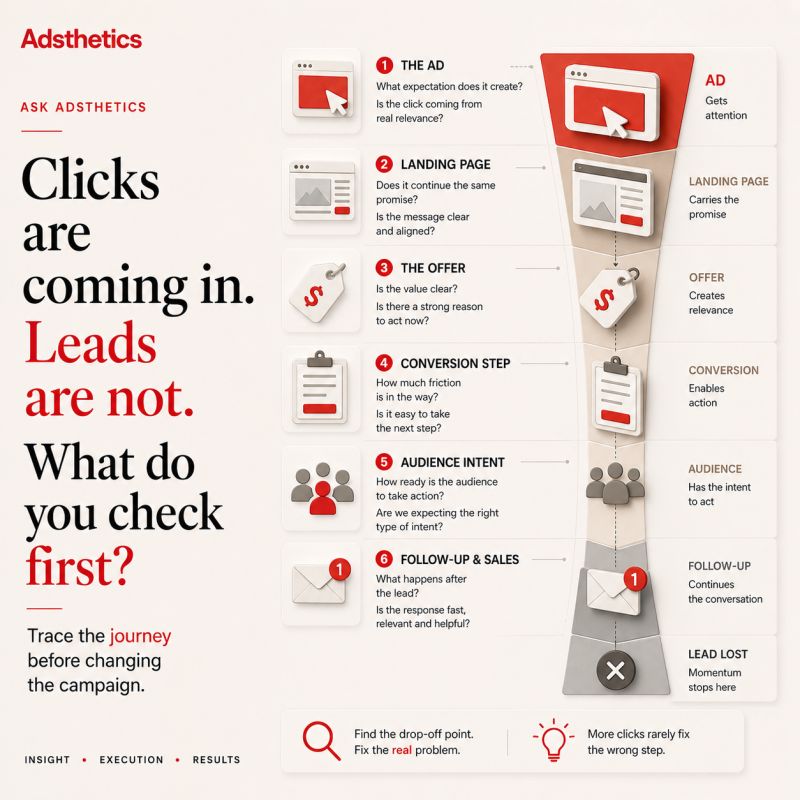
When paid ads generate clicks but no leads, changing everything at once usually hides the real cause. A better method is to trace the customer journey in order and stop at the first place where attention no longer becomes intent.
Diagnose in sequence: ad expectation, page continuity, offer, conversion step, audience intent and follow-up.
Start with the journey, not a random optimisation
Begin with the evidence you already have. Confirm that clicks, landing-page sessions and conversion actions are being recorded correctly before interpreting the absence of leads.
Then follow the route a prospect takes. This checklist keeps each diagnosis connected to the next step so the paid ads agency can change the real constraint rather than the most convenient setting.
Use a consistent date range, device view and audience segment where possible. Mixed data can make one part of the journey look weaker or stronger than it is.
1. Check the ad’s expectation and relevance
Ask whether the creative is relevant or merely interesting. Review click-through rate, search terms, audience placement and the exact promise that persuaded someone to visit.
Compare that promise with competitor messages and the concerns prospects express in sales calls, forums or social conversations. The ad should attract people who recognise the problem and are open to the solution.
If attention is broad but intent is weak, tighten the message or targeting before asking the landing page to solve the wrong traffic.
2. Review landing-page continuity and the offer
On arrival, the visitor should immediately see continuity: the same problem, audience, offer and next step introduced by the ad.
Check whether the value is specific enough and whether there is a credible reason to act. Use customer feedback and simple user tests to find language that creates uncertainty.
Compare the page’s conversion rate with its own historical baseline and relevant commercial context. Benchmarks are useful prompts, not substitutes for understanding the offer.
3. Test the conversion step for friction
Test the form, buttons, scheduling tool, phone links and confirmation flow on mobile and desktop. Watch for slow pages, broken fields and unclear error messages.
Reduce unnecessary commitment. Long forms, sensitive questions and multiple competing calls to action can make a qualified visitor postpone the decision.
Confirm that every successful submission reaches the correct person and is captured in reporting. A routing failure can create the appearance of zero demand.
Check audience intent and what happens after the lead
Now assess audience intent. A person may fit the demographic profile but still be researching, comparing or looking for information rather than a provider.
Finally, review response time, follow-up, qualification and the sales conversation. Advertising can create an enquiry, but the business still has to convert that opportunity.
Feed those outcomes back into the campaign. A high cost per lead may be acceptable when opportunities are strong; a cheap lead is expensive when it never had a realistic path to revenue.
The takeaway
Work through the checklist until the first loss of momentum becomes clear. Fix that point, measure the effect and then continue downstream.
This ordered approach turns “clicks but no leads” from a frustrating headline into a testable problem across the ad, landing page, next step and wider funnel.
Want a paid ads agency to trace the funnel and find where lead momentum is being lost? Talk to Adsthetics.