
Why Advertising Performance Recovers in Stages After Major Events
The event may be over, but audience attention, buying decisions and advertising algorithms rarely return to normal at exactly the same speed.
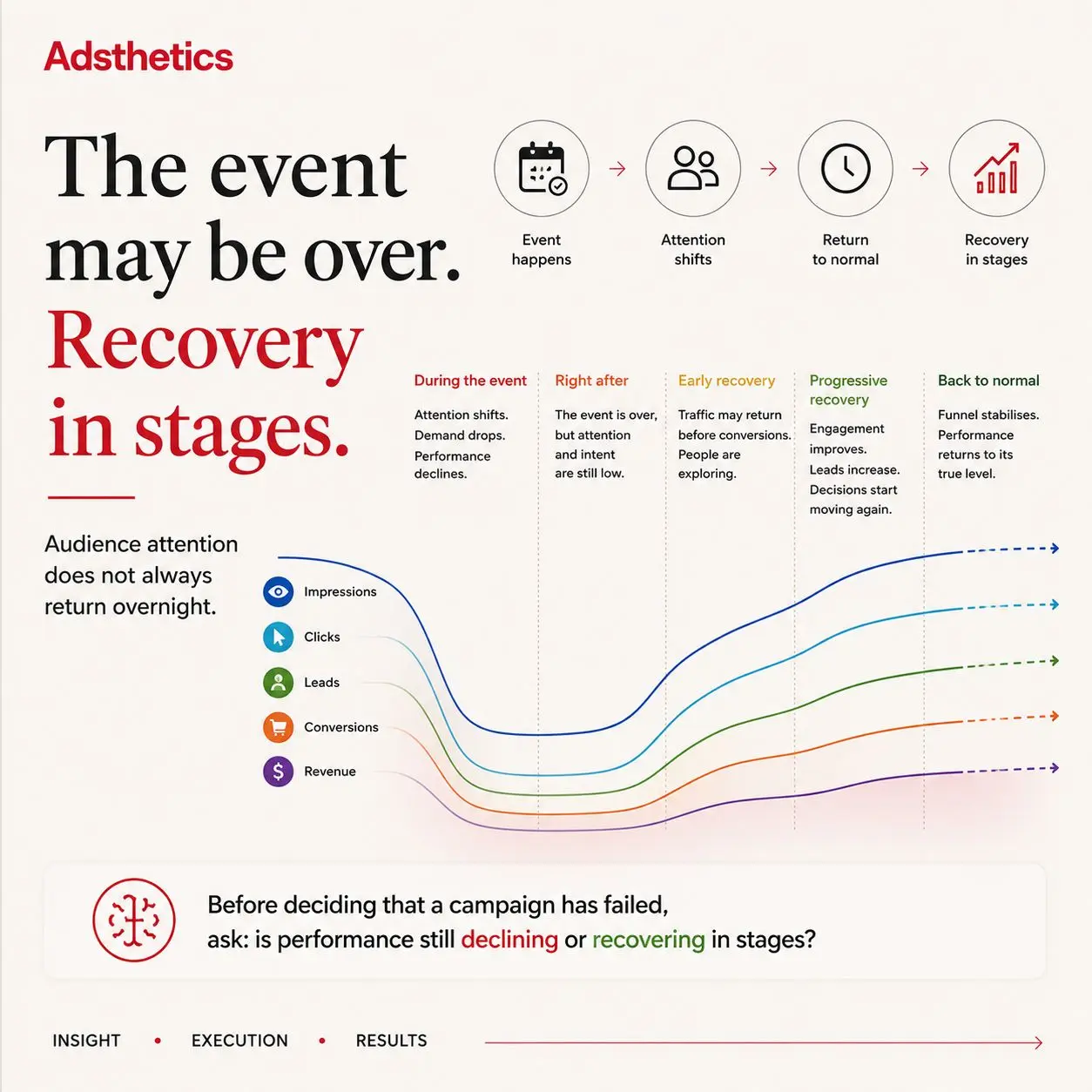
The event may be over, but audience attention, buying decisions and advertising algorithms rarely return to normal at exactly the same speed.
Audience attention can disappear quickly. It rarely returns all at once.
Buyer behaviour does not reset overnight
The event may be over. The behavioural effect may not be. The event may be over. But not the behavioural effect. Bank holidays, major public events, seasonal moments, and long weekends can quickly shift audience attention. And the return to normal is usually slower.
People do not immediately proceed to the exact point they stopped after a major event. They return to work. Catch up on messages. Rearrange priorities.
Revisit postponed decisions. Compare options they ignored while their attention was elsewhere. This means advertising performance may continue to look poor even after the event itself has ended: 1. Traffic may begin to recover before conversions do.
Traffic, conversions and sales recover at different speeds
2. People may start clicking again, but still delay decisions. 3. Leads may return, while sales conversations remain slower than usual. In longer decision-making cycles, the top of the funnel may recover first, while later stages are slow to catch up. Algorithms also need time to respond to changing demand. During the low-attention period, they may have redirected spend, adjusted keyword or audience selection, or learned from temporary behaviour only. Once demand returns, the system may not immediately return to its previous pattern.
That is why the first days after a holiday or major event can be misleading. The event is over. But the audience, the funnel, and the algorithm may still be recovering. It is always worth asking: Is the performance recovering in stages?
Because audience attention can disappear quickly. But it rarely returns all at once.
A practical checklist
Traffic recovery
Track whether impressions, search volume, reach and relevant clicks begin returning after the event. Traffic often recovers before buyers are ready to convert. Compare quality as well as volume so that broader, low-intent delivery is not mistaken for genuine market recovery.
Conversion recovery
Monitor landing-page actions, forms, bookings and purchases separately from click recovery. Conversion rates may remain depressed while people catch up and revisit postponed decisions. Use an appropriate evaluation window before concluding that the campaign has developed a new structural problem.
Lead-quality stability
Check whether returning enquiries still match the intended audience, need and commercial criteria. Stable lead quality with lower volume can indicate temporary demand weakness. Deteriorating relevance may instead show that the platform has shifted delivery towards easier but less useful traffic.
Sales-cycle recovery
Review response rates, meetings, proposals and close times. Leads may return before sales conversations regain their normal pace, particularly in B2B or considered purchases. Connect advertising data with CRM outcomes so delayed decisions are not misclassified as campaign failure.
Algorithm readjustment
Automated bidding and delivery may have adapted to temporary behaviour during the low-attention period. Watch search terms, audiences, placements and budget allocation as demand returns. Give the system time to readjust, but intervene when delivery remains concentrated in lower-quality areas.
The takeaway
Watch the shape of recovery across the funnel. Early traffic improvement can be encouraging even while enquiries or sales remain below normal, especially for longer buying cycles.
Need a clearer view of what your advertising is proving? Talk to Adsthetics.