
Who Should Own Your Advertising Accounts and Data?
Your business should own its ad accounts, tracking, audiences, creative and history—even when an advertising agency manages the day-to-day work.
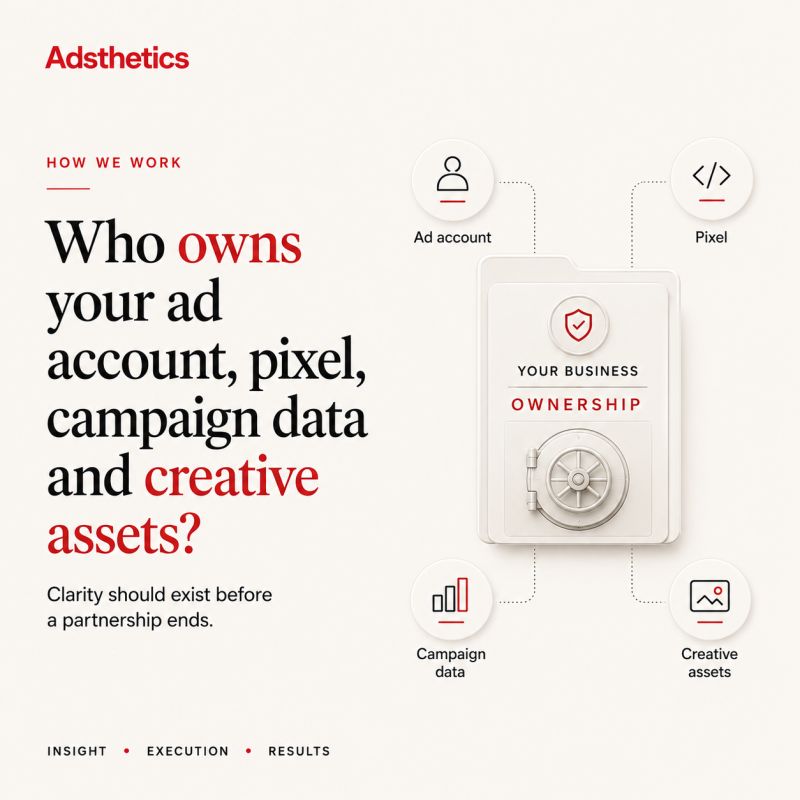
An advertising agency may manage your campaigns, but the infrastructure behind those campaigns should remain under your business’s control. Ownership protects continuity, visibility and the freedom to change partners without losing the system you paid to build.
Management can be delegated. Ownership, access and accountability should remain with the business.
The advertising account ownership principle
Business-owned infrastructure means the company is the primary owner or administrator of its Google Ads account, Meta Business portfolio, analytics, tag management and related conversion tools.
The agency receives the access it needs to work, but that permission can be reviewed or removed. The arrangement is clear from the start rather than negotiated during a difficult handover.
This is not about limiting collaboration. It creates a healthier relationship because both sides know the client can see the work, understand the setup and retain what has been created.
Own every platform account
Create ad accounts using company-controlled details and assign internal administrators wherever the platform permits. Avoid an arrangement where the only owner is an individual at the agency.
Review permissions regularly. People change roles, agencies use contractors and old access can remain active long after it is needed.
Business ownership also simplifies billing, security and platform support. When identity or payment issues occur, the company is not dependent on a third party to prove control.
Protect tracking, audiences and creative
Tracking belongs to the business because it connects advertising with customer behaviour. Pixels, conversion actions, analytics properties and tag containers should be visible and documented.
Audiences and creative are valuable assets too. The company should retain source files, usage rights, campaign variants and an explanation of how segments were built.
Ask how sensitive customer data is handled and which systems receive it. A paid ads agency should be able to explain permissions, consent and security without hiding behind technical language.
Keep history documented and portable
Campaign history contains years of market evidence: search terms, audience response, creative fatigue, budget changes and conversion patterns. Losing that history makes future decisions weaker.
Document naming conventions, account structure, tracking logic and major tests. Good records allow another qualified person to understand the system without reconstructing it from scratch.
At the end of a relationship, the business should keep its accounts, data, audiences, creative and learning. Only the agency’s access should disappear.
Questions to ask before appointing an agency
Ask who owns each Google Ads and Meta asset, who holds administrator access and whether the company can log in independently today.
Confirm what happens to tracking, historical data, audiences and creative if the relationship ends. Request a practical handover process rather than a vague promise of cooperation.
Finally, ask how decisions are documented. Ownership is most useful when the business can understand the system, not merely possess credentials for it.
The takeaway
Account ownership is a basic form of accountability. It gives the business visibility into its paid advertising investment and prevents unnecessary dependency on a provider.
A trustworthy advertising agency should welcome that arrangement. Its value should come from strategy, management and judgement—not from controlling access to the client’s own infrastructure.
Want advertising management built around transparency and business ownership? Talk to Adsthetics.