
Why Do Ads Get Clicks but No Leads?
A click shows interest, not intent. When paid ads attract traffic but no enquiries, diagnose the promise, page, offer, audience and follow-up as one connected journey.
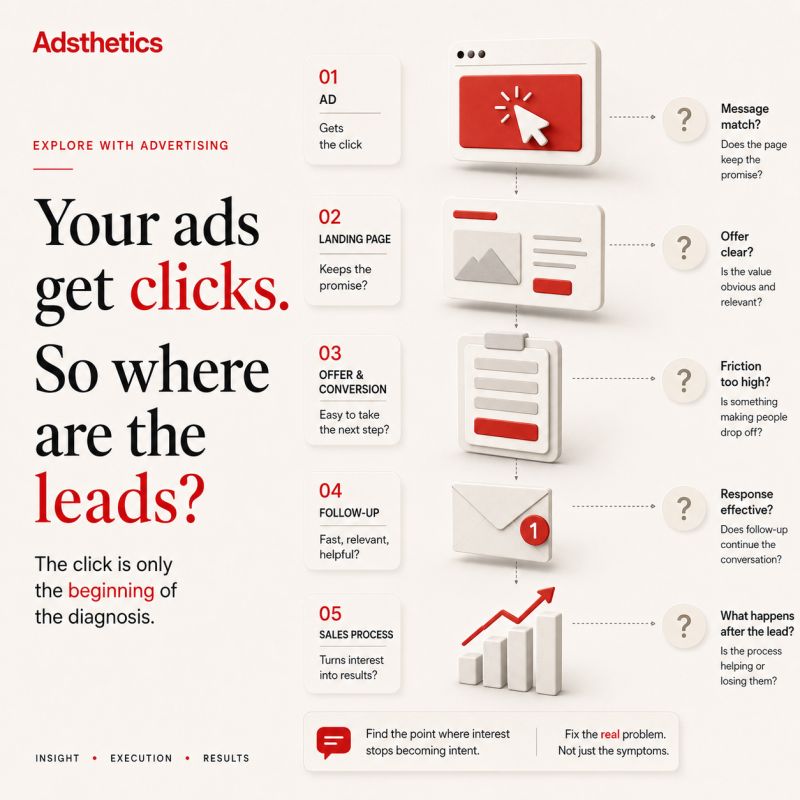
Ads can earn a healthy click-through rate and still produce no leads. That does not automatically mean the media campaign has failed. It means attention is not becoming enough intent to complete the next step.
The better question is not “Why are people clicking?” It is “Where does interest stop becoming intent?”
Why paid ad clicks do not automatically become leads
A click confirms that something in the ad was relevant, interesting or visually compelling. It does not confirm that the visitor understood the offer, trusted the business or felt ready to enquire.
That distinction matters because platforms optimise what they can observe. If the creative attracts curiosity without commercial intent, the campaign can look active while the pipeline remains empty.
Diagnosing the gap requires a full-funnel view. The ad, landing page, offer, audience, form, response process and sales conversation can each weaken momentum.
Check the promise and message match
Compare the expectation created by the ad with the first message on the landing page. The language, audience, problem and proposed next step should feel continuous.
A mismatch forces the visitor to reinterpret the offer. Even a small change in emphasis—from a specific service to a broad company introduction—can reduce confidence.
Review search terms, audience signals and creative angles as well. High engagement may be coming from people who enjoy the content but do not need the solution.
Make the offer easy to understand
Visitors should be able to explain what is being offered, who it is for, why it matters and what happens next without searching through the page.
An offer can be relevant but still feel weak if the value is vague, the commitment is too high or there is no reason to act now. Test clarity before adding more persuasion.
Use customer questions, sales objections and user feedback to strengthen the page. The language prospects use often reveals what the advertising copy has left uncertain.
Remove unnecessary conversion friction
Every additional field, slow-loading element, confusing button or unexpected request creates friction. Check the conversion step on mobile and desktop as a real visitor would.
Match the size of the ask to the visitor’s readiness. A first-time prospect may respond to a short consultation request but avoid a long form demanding information they have not prepared.
Technical failures matter too. Test forms, confirmation messages, call tracking and routing so a genuine enquiry cannot disappear between the website and the team.
Trace the whole conversion journey
The journey continues after submission. Slow response, weak qualification or an unclear sales handoff can make successful lead generation look like poor advertising.
Connect campaign data with CRM or sales feedback wherever possible. That shows whether the problem is before the lead, during conversion or after the enquiry arrives.
A good paid advertising agency diagnoses across those boundaries instead of changing bids or creative simply because the platform is easiest to edit.
The takeaway
Clicks without leads are a symptom, not a complete diagnosis. The task is to find the first point where relevance, clarity, trust or momentum breaks.
Once that point is visible, the fix becomes more specific: change the targeting, align the message, improve the offer, reduce friction or repair the follow-up rather than guessing.
Getting paid ad clicks without the enquiries your business needs? Talk to Adsthetics.