
The First 90 Days of Paid Advertising: What to Expect
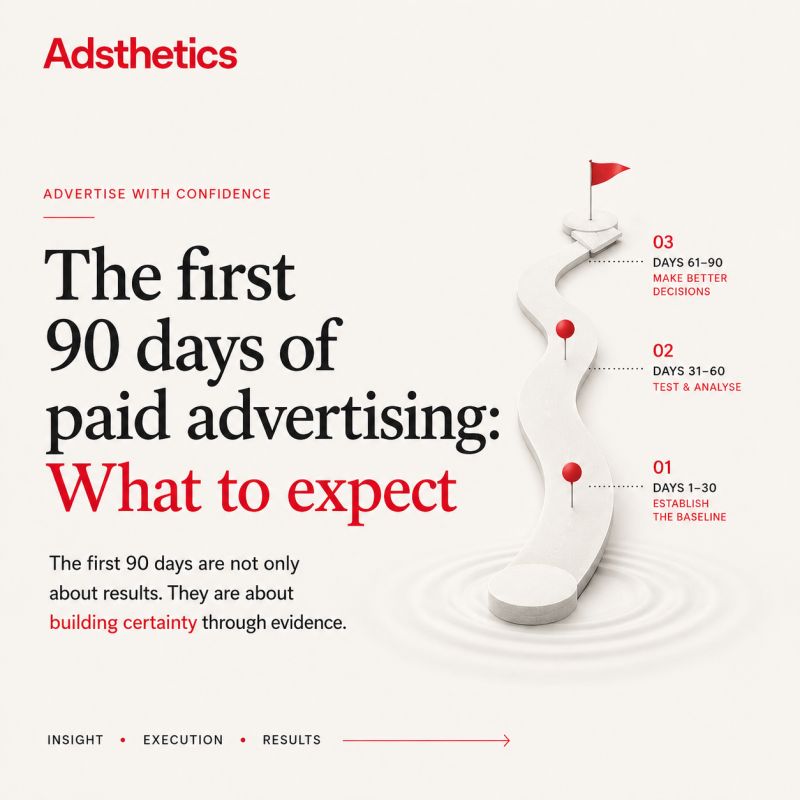
The first 90 days are not only about results. They are about building certainty through evidence.
Starting paid advertising can feel like a test of nerve. You set a budget, launch campaigns and wait for a clean answer. In practice, the early stage is less about instant certainty and more about creating the conditions for better decisions.
Good paid advertising does not begin with certainty. It builds certainty through evidence.
What the first 90 days are really for
The first 90 days of paid advertising are where your strategy meets the market. They show how real people respond to your offer, which messages earn attention, what creates intent and where the journey introduces friction.
That evidence matters because a campaign plan is still a set of assumptions until people interact with it. Search terms, audience behaviour, creative response, lead quality and conversion data begin to reveal which assumptions are useful and which need to change.
This does not mean results are unimportant. It means early results should be read alongside the quality of what you are learning. A healthy first 90 days should make the next decision clearer: what to maintain, what to adjust, what to stop and where additional investment has earned its place.
Days 1–30: establish the baseline
The first month is about getting a trustworthy starting point. Tracking should be checked, useful conversions should be defined and the campaign journey should connect the ad promise to the landing page and the action you want someone to take.
You are also learning what the market gives you: which searches appear, which audiences engage, how much traffic costs and whether attention turns into meaningful enquiries. The first numbers may be uneven. That is normal. Their job is to establish a baseline, not to deliver a final verdict.
Record what is happening by channel, audience, message and stage of the funnel. Where possible, connect form fills or calls with sales feedback so the campaign is optimised for useful demand rather than the cheapest visible action.
Days 31–60: test and analyse
With a baseline in place, testing becomes more deliberate. Compare messages, audiences, keywords, creative approaches and landing-page paths one meaningful variable at a time. The aim is not to change everything quickly; it is to understand why performance changes.
Patterns start to emerge during this stage. One message may attract curiosity without intent. A narrower keyword group may produce fewer clicks but stronger conversations. A creative idea may work for one audience and fall flat for another.
Those differences are valuable. They turn broad opinions into specific evidence and help the campaign move from exploration towards a repeatable approach.
Days 61–90: make better decisions
By the third month, repeated signals should carry more weight than isolated wins or bad days. This is where the account can become more focused: budget can move towards stronger opportunities, weak assumptions can be retired and promising routes can be refined.
The useful questions become more commercial. Which audience or search theme deserves further investment? Which offer is easiest for the market to understand? Where is the gap between a click and a qualified enquiry? Is there enough evidence to scale, or would another focused test reduce risk first?
The answer will not always be “spend more”. Sometimes the best decision is to improve the offer, tighten qualification, rebuild part of the landing experience or keep gathering evidence at the current level.
How to judge progress without chasing perfect results
Ninety days is a useful planning frame, not a guaranteed performance deadline. A local service with frequent enquiries can learn faster than a high-value B2B business with a long sales cycle. Budget, demand, seasonality and the amount of reliable conversion data all affect the pace.
Judge progress by whether the campaign is producing clearer evidence and better decisions. Are you learning which messages create qualified interest? Can you explain where prospects hesitate? Is reporting connected to business outcomes? Are changes being made because of a pattern rather than a reaction?
The strongest accounts often look more disciplined by day 90, not simply busier. They have clearer priorities, fewer unsupported assumptions and a better view of the relationship between spend, attention and commercial value.
The takeaway
The first 90 days should leave your business with more than a collection of campaign metrics. They should create a clearer advertising system: a dependable baseline, documented learning and evidence that shows what deserves to be refined or scaled next.
Expect testing. Expect some assumptions to be wrong. Most importantly, expect every meaningful result to improve the quality of the next decision.
Need a clearer view of what your advertising is proving? Talk to Adsthetics.