
Insight
The academy came to us at the beginning of its paid-advertising journey, with several growth priorities competing for attention.
The academy needed to attract new pupils across different stages, support sixth-form and SENIP enrolment, recruit staff and trainee teachers, and promote paid courses.
These were not variations of one audience. Parents, prospective students, job candidates and course buyers each had different motivations, concerns and decision timelines.
This created a fundamental constraint.
A single broad campaign would blur the message, while search alone could only reach people already expressing an immediate need.
This reframed the problem:
The task was to define each audience deeply enough to build demand before consideration, then capture intent reactively when people began searching.
Execution
We built the strategy around deep audience research, demand building and reactive demand capture.
The first phase mapped each objective to its own decision journey.
We researched the behaviours, barriers and language of families considering the academy, sixth-form and SENIP options, potential employees, initial teacher-training candidates and course buyers.
This gave every campaign a clearer job: introduce the right opportunity, answer the audience’s real concerns and qualify attention before asking for action.
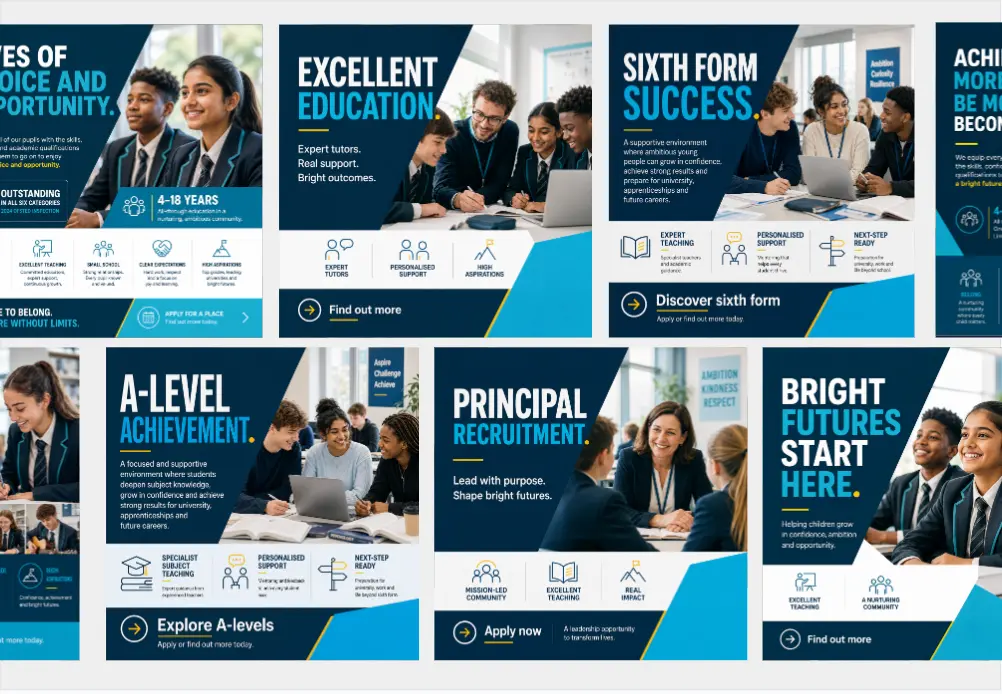
Meta Ads created demand through audience-specific messaging and creative concepts. The academy also became our first implementation of AI-assisted creative production, allowing more relevant visual directions to be developed and tested efficiently.
Alongside this, Google Ads captured active demand from people already searching for schools, sixth-form places, specialist provision, teaching opportunities and courses.
The account was structured around distinct outcomes rather than one generic conversion.
Search terms, audience response and creative performance were then used together to refine targeting and budget allocation.
The result was a unified system:
- Audience research → define motivations, barriers and decision-makers
- Meta Ads and AI-assisted creative → build demand and qualify attention
- Google Ads → capture high-intent searches at the moment of need
Together, these layers helped the academy recruit, grow student numbers and sell courses without forcing different audiences through the same message.
Results
The shift from broad promotion to audience-specific demand creation and capture delivered measurable growth across the academy’s priorities.
- 58% increase in student enrolment over the year
- Growth across sixth form, SENIP and initial teacher training
- 33% lower cost per action than the wider industry benchmark
The campaigns also established a repeatable way to support recruitment, admissions and course sales from one coordinated advertising system.
More importantly, the academy gained clearer evidence of which messages and channels moved each audience from awareness to action.